
Syria: Stories of how inclusive education is reaching children left out of school
4 minutes read
From isolation and loss to hope and ambition, children across Syria are reclaiming their right to learn. Through flexible, inclusive education, stories like Mohamed’s and Salsabeel’s show how support can turn exclusion into opportunity—and spark new dreams for the future.

“I used to cry when I watched the children playing outside. They were free—laughing, running and living life. And there I was, trapped at home like a prisoner. I hated my life. I felt useless.”
Born with quadriplegia, Mohamed spent much of his childhood confined to his home, as conflict, poverty and physical inaccessibility limited his opportunities. Doctors advised his family to lower their expectations for his future—but his mother, Safa, refused.
Two years ago, Safa learned about a mobile education team supported by UNICEF and funded through GPE, offering self-learning classes for out-of-school children in Darayya. She enrolled Mohamed without hesitation.
Recalling his first days in the program, Mohamed’s face lit up. “The course was amazing,” he said. “The teachers were patient and understanding, and they respected my struggles. They helped me with reading, writing and math.”
The impact has been profound. Mohamed now reads confidently and often wins Holy Quran verse competitions with his brothers.
For him, inclusive education is not only about being in school. It is about being seen, supported, and able to participate in society with confidence and dignity.
Today, his ambitions continue to grow. “I want to keep studying, improve my math, and one day open my own grocery store,” he said. “I am still scouting locations, looking for the best spot. It is going to be huge and fancy.”
Safa looked on with pride. “I know this young man better than anyone,” she said. “When he sets his mind to something, nothing will stand in his way.”
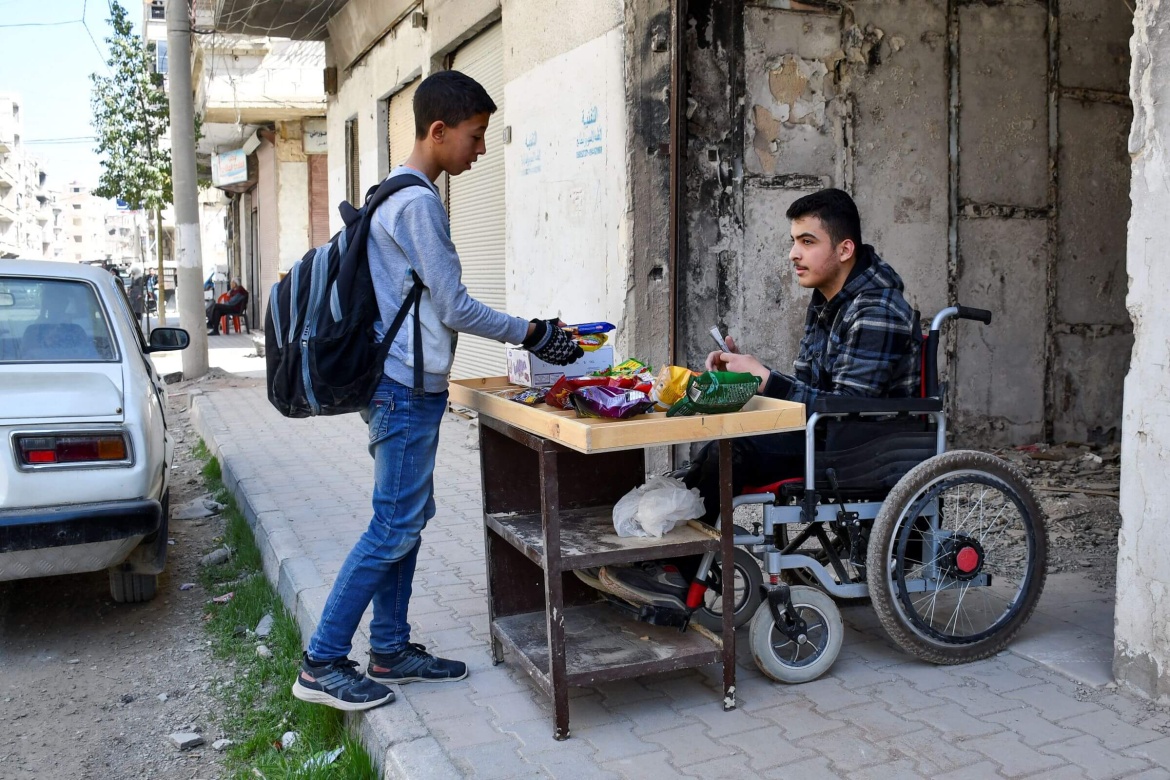
Mohamed 17, sells some candies to a passenger in Darayya City in rural Damascus, Syria.
Credit:
UNICEF/UNI795643/Shahan
Salsabeel, Lattakia: Adapting to new ways of learning after vision loss

“At first, my sight was weak, but I could still study and go to school on my own. But when I lost it entirely, everything went dark—along with my hope.”
Salsabeel has endured profound loss. A shelling attack in Idleb took her parents and eldest sister and left her with severe visual impairment. Over time, as her sight faded, continuing school became increasingly difficult.
Despite unwavering support from the rest of her family, she began missing classes and felt her dreams were slipping away.
Eventually, she turned to non-formal learning, supported by GPE and partners, accessing lessons through her phone and an educational app. This allowed her to continue studying independently and regain a sense of purpose.

Rima, 15, helps her sister Salsabeel, 17, revise a lesson in their apartment in Lattakia City, Syria.
Credit:
UNICEF/UNI776496/Haddad
A safe and supportive learning space in Dar’a

"These children inspire us every day. We learn courage, resilience and determination from them."
Years of conflict and displacement in Dar’a have disrupted children’s access to education, particularly for children with disabilities. Many have been unable to enroll in formal schools due to damaged infrastructure, lack of support services and inaccessible learning environments.
To bridge this gap, with funding support from GPE, UNICEF established a self-learning center in Dar’a city.
The center offers non-formal education tailored to children with disabilities who have been excluded from the formal system. It focuses on foundational literacy and numeracy, communication and life skills, using play-based and child-centered approaches. Facilitators work closely with each child, adapting lessons to their needs and pace.
For many children, progress begins with small but transformative steps—making eye contact, recognizing sounds or colors, or speaking their first words. These milestones represent meaningful breakthroughs for children who were previously excluded from education.
Beyond academics, the center provides a safe, supportive environment where children feel accepted and encouraged. For families, it offers reassurance that their children are learning and growing with dignity.
The experience in Dar’a shows how flexible, education models can give children with disabilities a second chance to learn—even in the most challenging contexts.
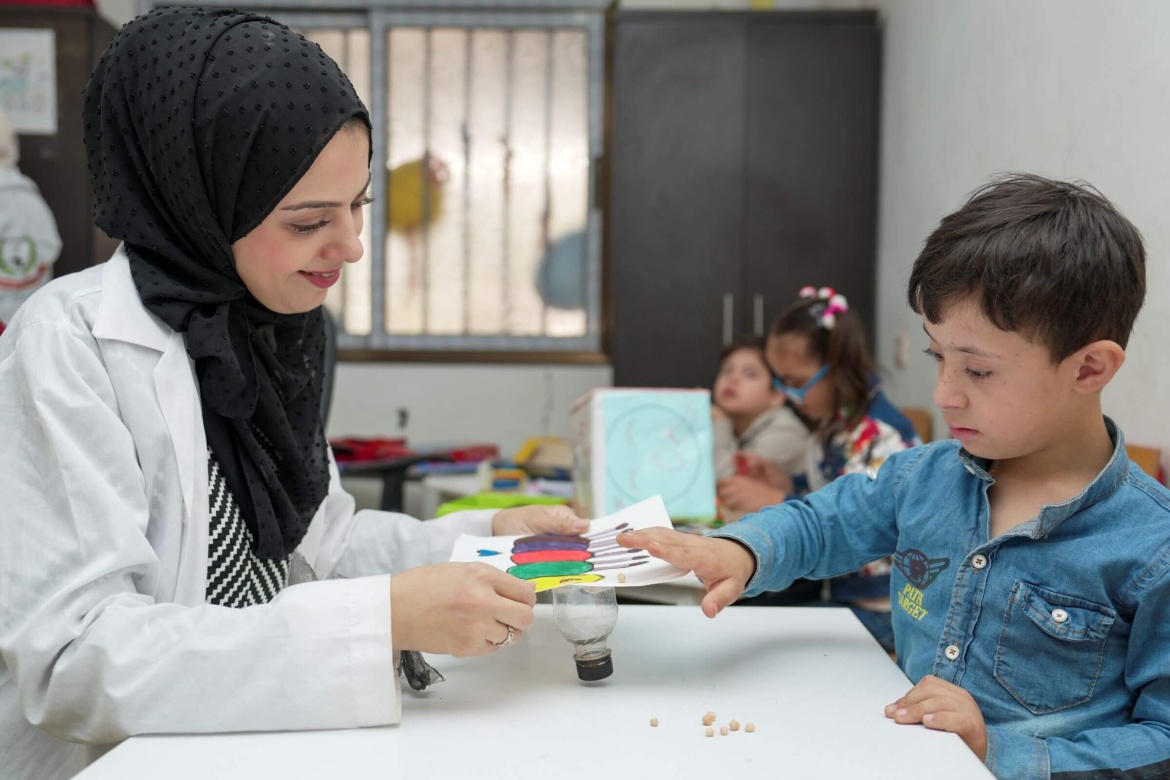
Anwar helps Mohamed, 6, through an educational game. Dar’a city, Syria.
Credit:
UNICEF/UNI873440/Shahan
Strengthening inclusive education
GPE is supporting efforts to strengthen inclusive education in Syria, enabling children who are out of school—particularly those with disabilities—to access flexible, learner centered education opportunities.
Today, more than 400,000 children across Syria have accessed non-formal education supported by GPE and partners. Behind each number is a story like Mohamed’s or Salsabeel’s - a child rediscovering learning, confidence, and a sense of possibility even amid conflict and loss.
Leave a comment
Your email address will not be published. All fields are required.