What we do
Our vision
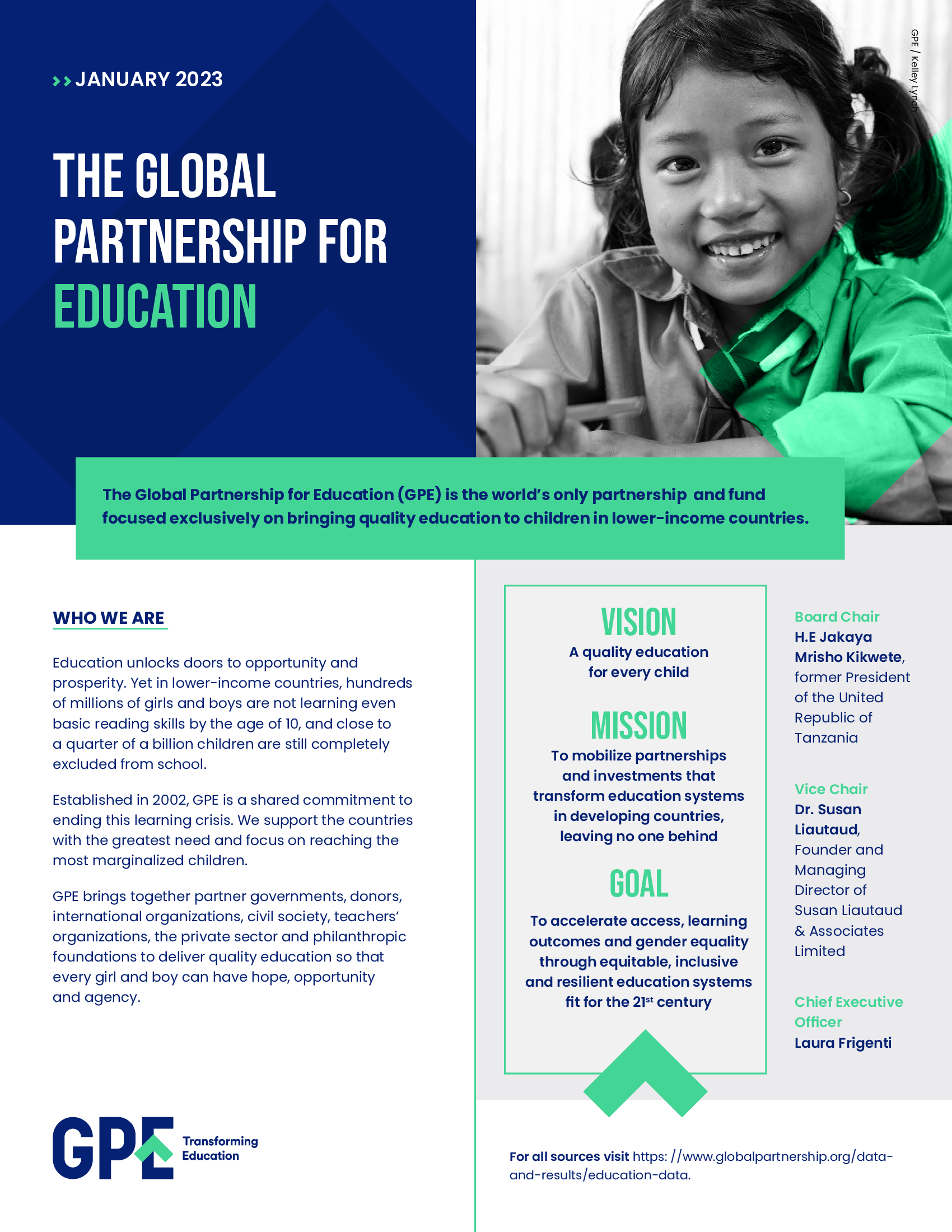
A quality education for every child
Our mission
To mobilize partnerships and investments that transform education systems in lower-income countries, leaving no one behind
Our goal
To accelerate access, learning outcomes and gender equality through equitable, inclusive and resilient education systems fit for the 21st century
Transforming education is about creating impact at scale so that every child receives a quality education. GPE helps governments make systemic changes and align resources and funding to deliver education for the most marginalized children, raise learning levels, withstand shocks and adapt to new challenges.
GPE convenes partners around policy dialogue to determine how to best support each country collectively, based on agreed national priorities. It facilitates participation and accountability from all education stakeholders.
Partners
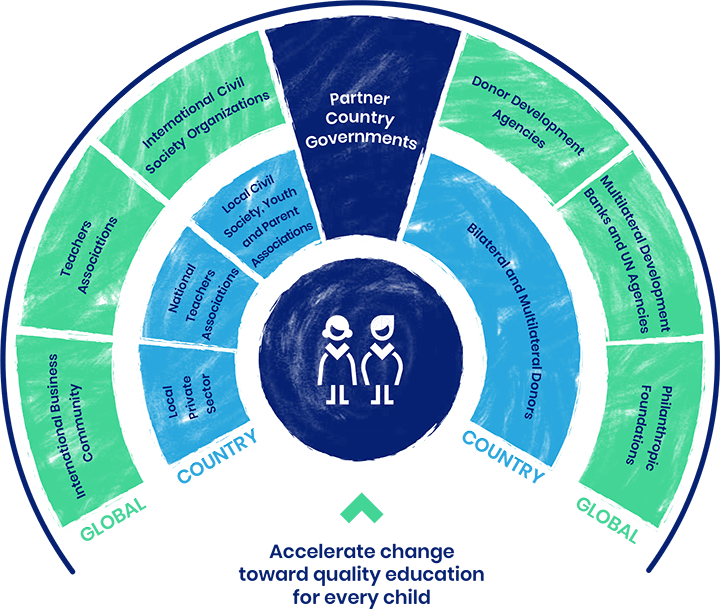
GPE brings together all partners invested in education --lower-income countries, donors, international organizations, civil society, including youth and teacher organizations, the private sector and private foundations-- to transform education systems focusing particularly on the places and people with the greatest needs.
GPE champion

Janet Mbugua, a Kenyan media personality and gender equality advocate, is a GPE champion.
In this role, she encourages world leaders and policy makers to support global education and gender equality.
The award-winning humanitarian, who has empowered thousands of girls and women through her work, promotes GPE’s objectives to help transform education and create a future where every girl and boy can realize their full potential.
Principles
The GPE Charter enumerates 8 principles for the partnership:
- Education as a public good, a human right and an enabler of other rights
- Focusing our resources on securing learning, equity and inclusion for the most marginalized children and youth, including those affected by fragility and conflict
- Achieving gender equality
- Enabling inclusive, evidence-based policy dialogue that engages national governments, donors, civil society, teachers, philanthropy and the private sector
- Providing support that promotes country ownership and nationally identified priorities, and is linked to country performance in achieving improved equity and learning
- Improving development effectiveness by harmonizing and aligning aid to country systems
- Promoting mutual accountability and transparency across the partnership
- Acting on our belief that inclusive partnership is the most effective means of achieving development results
The GPE 2025 strategy is built around 4 principles for an effective partnership:
- Increased decentralized mutual accountability
- Rebalanced country-level model
- Strengthened national government ownership and capacities
- Reduced GPE processes and transaction costs
Our strategy
GPE 2025 is the partnership’s strategic plan for 2021 to 2025. The strategy provides a platform to bring together GPE’s unique assets and ways of working in support of ambitious education transformation in the most vulnerable countries.
GPE 2025 is aligned and directly addresses SDG 4. Over the 2021-2025 period, GPE will accelerate children’s access to education while improving learning and catalyzing greater equity and gender equality.
GPE will pursue its vision, mission and goal through 3 country-level objectives:
- Strengthen gender-responsive planning and policy development for system-wide impact
- Mobilize coordinated action and financing to enable transformative change
- Strengthen capacity, adapt and learn to implement and drive results at scale.
These objectives are supported by an enabling, global objective: to mobilize global and national partners and resources for sustainable results.