
Education systems are complex. They are composed of multiple actors and components that must work together to facilitate learning. Strong education systems are responsive and resilient, reaching all girls and boys with quality learning opportunities.
GPE works to transform education systems holistically, based on a deep understanding of country context and evidence. Strengthening government-led education systems is crucial to realize the ambition of GPE 2025.
GPE promotes policy dialogue to identify key education priorities that have the potential to unlock system-wide change. GPE also works to align external support to these priorities and jointly monitor, learn and adapt during implementation to build evidence and enable course-correction.
As a partnership, GPE brings together donors, multilateral institutions, civil society, teacher representatives, philanthropic foundations and the private sector behind partner country governments' plans.
As a fund, GPE provides financing to catalyze reforms and support national action and commitment.
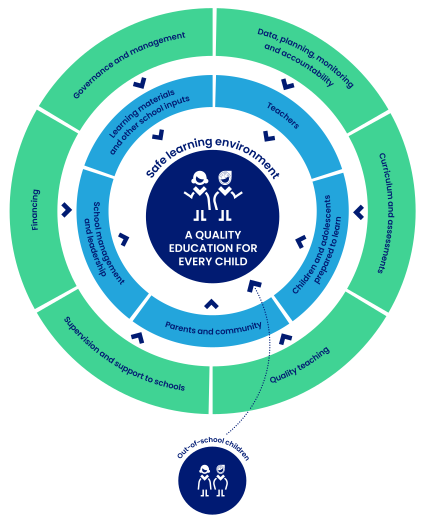
Our approach
GPE 2025 aims to support countries to deliver system transformation. Its core components allow to strengthen mutual accountability, sharpen the focus of policy dialogue and mobilize partners' collective capabilities to reinforce country capacity.
GPE supports mutual accountability by strengthening partner countries' education sector coordination mechanisms (local education groups). GPE works to ensure these groups are effectively led by the government and include representation from all key stakeholders, including civil society organizations, teacher associations, donors, multilateral agencies as well as private sector and foundation partners.
Learn more:
The GPE operating model is based on three stages to support countries to move from analysis and diagnosis to prioritization and alignment, and finally to implementation, learning and adapting.
- Step 1: Assess and diagnose: Partners in the local education group review policy frameworks, sector performance, needs, gaps and existing evidence to identify critical bottlenecks and priority reforms that have the potential to leverage system transformation. This process leads to a nuanced, context-sensitive analysis of the education system. The analysis discusses a country's performance under four enabling factors to support system transformation:
- Data and evidence
- Sector coordination
- Gender-responsive planning
- Volume, equity and efficiency of domestic public expenditure on education
The Independent Technical Advisory Panel (ITAP) subsequently assesses a country’s status against the four enabling factors to further inform the development of the partnership compact and GPE’s financing of system reform.
- Step 2: Prioritize and align: The ministry of education, with its partners, prepares a partnership compact to align partners and resources behind a prioritized reform area. The partnership compact is a new key strategic tool to drive system transformation. It drives the country's focus on sector bottlenecks and transformative solutions to address them. It allows to adapt the GPE model to each country context, defines GPE's engagement and ensures that partners' financing is complementary and harmonized.
- Step 3: Act on evidence, learn and adapt. The country and its partners implement the agreed programs and reforms, with gender hardwired throughout the process, improved access to data and tracking agreed results. This in turns increases accountability and allows evidence-based course correction during implementation.
As conveners and facilitators of partnership, coordinating agencies play a critical role in delivering on GPE’s vision, mission, goals and objectives.
Funding system transformation
To support the process as well as broader coordination, planning and learning, eligible partner countries can access financial support:
- System capacity grants support analysis, gender responsive planning, data and longer-term system capacity to plan, implement and monitor the sector. These grants are available throughout the policy cycle.
- System transformation grants target specific, prioritized reforms that enable system transformation
- Girls' Education Accelerator grants support gender equality in countries and regions where girls' education is identified as a key challenge.
- Multiplier grants allow countries to leverage additional external funding from partners alongside GPE funds.
System capacity and Multiplier grants are available to all partner countries eligible to receive funding, while system transformation grants and the Girls' Education Accelerator grants are available to countries that meet certain eligibility criteria. See the list of eligible countries.
Grant agents play a critical role in delivering GPE’s vision, mission, goals and objectives. They are assigned to receive GPE grant funds, either on behalf of a partner country or for specific programs such as KIX and Education Out Loud.
Technical assistance and other initiatives
GPE leverages the full breadth of the partnership by collaborating with global and regional partners to provide countries with capabilities critical to education system transformation.
- Delivering complementary capacity, expertise or solutions to countries. GPE is piloting an approach to match countries with organizations that have strategic capabilities, which can help to reinforce ministry capacity to address education and cross-sectoral challenges.
- Driving knowledge-sharing and innovation. GPE offers access to regional and global solutions, including advisory services where partner expertise can strengthen capacity. Partner countries also benefit from knowledge sharing and financing for innovation through the GPE Knowledge and Innovation Exchange (KIX).
- Supporting advocacy and social accountability. Through Education Out Loud, GPE reinforces civil society's capacity to engage in education sector planning, policy dialogue and monitoring at the national level, and strengthens the enabling environment for civil society advocacy and transparency efforts in education globally and regionally.
Support to education in crisis situations
In crisis situations, partner countries may access funds to build resilience and mitigate the impact of crises on the education system.
GPE supports countries affected by fragility or conflict through:
- Transitional education planning: GPE provides financial and technical support to help countries establish transitional education plans or frameworks, to create a foundation for a coordinated approach to recovery by identifying priority and medium-term actions.
- Operating principles in complex emergencies: These principles provide guidance on GPE engagement in situations of total or considerable breakdown of national authority resulting from conflict, including on the coordination principles that GPE should follow.
- Inclusion of refugees: GPE encourages the inclusion of refugees and displaced populations in education sector plans and policies and is strengthening the partnership by bringing in key actors such as UNHCR to address the needs of displaced and refugee children affected by conflict and crisis.