
Impressions from my trip to Senegal and South Sudan
During the week of May 27, I had the tremendous opportunity to make my first visit to Africa – to Senegal and South Sudan – as Chief Executive Officer of the Global Partnership for Education (GPE). As different as these two countries are, they both underscore the value of GPE’s country-driven model. While Senegal is shifting its focus to the quality of its education system, South Sudan – barely two years old as an independent nation – is working hard to put in place an education system that works to train teachers and reach vast numbers of out-of-school children. Two completely different sets of circumstances, two completely different sets of needs. In both cases GPE is supporting governments as they work to build lasting, high-quality education systems. I cannot think of a better example of sustainable development.
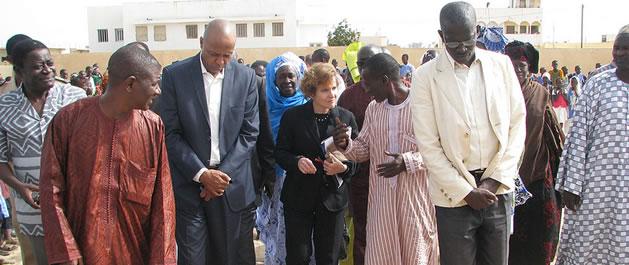
In each country, I was profoundly struck by witnessing GPE’s core principle of partnership in action. In Dakar and Juba, I met with government officials, teachers, students, parents, civil society organizations, donor partners, and United Nations organizations – all utterly committed to achieving education for all. In the seaside town of Kayar in Senegal, the local school is a community-wide effort, and parents and city officials turned out to greet the GPE delegation. In South Sudan, I was deeply impressed with how the Bangladesh-based non-governmental organization BRAC has worked with local communities and the South Sudanese government to establish schools in the fast-growing outskirts of Juba. Partnership is a good core value. It is even better when put into practice, as I saw close up on this trip.
A paradigm shift in Senegal
Senegal joined the Global Partnership in 2006 after the endorsement of its education sector plan by the development partners’ group. A GPE grant agreement of $ 81.5 million was signed in July 2009 with the objective of contributing to Senegal’s goal of attaining universal primary education by 2015 through constructing and equipping of classrooms. Progress has been made in getting more children in school. The primary school completion rate rose from 60% in 2009 to 66.5 % in 2011. Reaching gender parity in primary school is one of Senegal’s most important accomplishments in recent years. If the current trend is maintained, gender equity will be achieved in secondary education within three years and only a few years later in higher education. These are good results.

GPE Chief Executive Officer Alice Albright is greeted by children during her visit to their school in Kayar, Senegal. Credit: GPE/David K. Bridges
The new GPE grant of $46.9 million recently approved by the GPE Board of Directors will support the education sector plan for 2013-2020. It will build on prior achievements, and complement the previous grant. After focusing on access through school construction, the focus is now on the quality of education.
During my visit, I had the opportunity to speak at length with President Macky Sall and Minister of National Education Serigne Mbaye Thiam about their vision for the role of education in transforming Senegal. I was very encouraged by their strong commitment to education. Most interestingly, under the leadership of President Sall, Senegal is pioneering an effort working with the numerous Koranic schools (called daaras) of the Islamic community. The government provides support to the teaching of the Koran in exchange for the Koranic schools allowing for a wider curriculum that will mainstream Koranic education into a Franco-Arabic education. A significant proportion of the new GPE grant is committed to this program. I was able to observe an early success in the program when I visited the Ahmed Sakhir Lo Daara in the village of Boune, where the local community and the government are working together to provide a good education for their children – boys and girls alike.
Starting from scratch in South Sudan . . . but fully committed
The situation in South Sudan is quite different than in Senegal. Hardly two years old, South Sudan is faced with the daunting task of building an education system from scratch. The challenges are immense. Two decades of civil war shattered the society and what little infrastructure it had. Government revenues are heavily reliant on oil exports, and the 2012 suspension of exports resulted in a rapid depletion of financial reserves. Additionally, South Sudan’s large pastoralist communities require creative approaches to education, as they are semi-nomadic and the value of “formal” education, particularly for girls, is not a given.

GPE CEO Alice Albright with Simon Mphisa, Head of the Education at UNICEF in South Sudan. Credit: GPE/David K. Bridges
Given these challenges, I was very impressed with the commitment to education I saw in South Sudan. Having received a GPE grant of $36.1 million last year and with strong support from donor partners, United Nations agencies, and non-governmental organizations, the South Sudanese government is moving ahead with an education program focused on strengthening a national education system, improving service delivery, and putting in place an early phase of a program to improve learning outcomes. In my meetings with Minister of Education Joseph Ukel Abango and Under-Secretary Deng Deng, South Sudan’s optimism was on full display.
During visits to three schools in the Juba area, I saw firsthand both the challenges faced (little to no infrastructure and a lack of basic school materials, just to name two) and the hope and innovation being employed to meet the challenges. BRAC and the Government are working in and with communities to build schools, teachers are tirelessly committed to their students, and students are proud to be able to read and to sing their national anthem. Yes, it is all from scratch, but with the good work being done by so many in South Sudan, I left reassured that South Sudan will get there.