
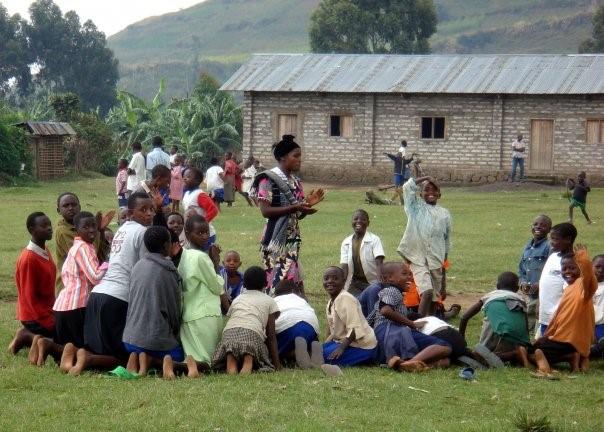
Nearly a decade ago, I worked in the Democratic Republic of Congo (DRC) with children in local primary schools to create ‘back to school’ messages to be aired on the radio. We asked, “Why do you want to go back to school?” I remember the children’s answers like it was yesterday. They were honest and inspiring:
“So I can learn and one day be president!”
“Because I miss my friends!”
“To contribute to the future of Congo!”
Localized, armed violence throughout North Kivu in the DRC forced schools to close their doors.Every day those doors were closed, the risk that some students and teachers would never return to the classroom increased. We knew that, when children weren’t in school, they were also at higher risk of violence, recruitment, and child labor.
We also knew that families, and especially children, ranked education as a top priority, despite their many other needs. However, we were struggling to raise the funds needed to help schools re-open and stay open.
Conflict keeps children from school

Every day that children are out of school, the risk of going back decreases. Child out of school in North Kivu, DRC.
Photo Credit: UNICEF/Lisa Bender 2008
That was in 2008 and yet today, conflict remains a major factor keeping children out of school. Education continues to receive less than 2% of humanitarian appeals. We have to do more, and we have to do better.
Based on a recent review of 22 countries affected by conflict[1], UNICEF found that nearly 24 million children living in crisis zones are out of school. The analysis highlights that nearly one in four of the 109.2 million school-aged children who live in conflict areas are missing out on their education.
Those countries that most need the benefits of education are often those with the most children missing out on education. South Sudan is home to the highest proportion of out–of-school children with over half (51%) of primary and lower secondary age children not accessing an education. Niger is a close second with 47% children unable to attend school, followed by Sudan (41%) and Afghanistan (40%). (UNICEF press release).
In countries affected by conflict, data is extremely difficult to collect so these numbers only tell part of the story. Numbers change every day as families are forced to flee or as areas become inaccessible to aid and development partners. Conflict is complex and protracted. We can no longer say that education will be prioritized once things get better; wee have to act as soon as we can, so that millions of children don’t lose out on their education.
Absence from school can lead to more violence
Headlines tell shocking stories of children abducted and viciously attacked. Sadly, when children are not safely in school, there are also less visible but as damaging consequences: girls are married off at younger ages, unaddressed trauma can stunt development, and a the gap between those who have opportunities at a better life and those who do not widens.
It is not our responsibility to ensure that children just survive, we must also ensure they thrive. UNICEF and a strong coalition of partners, including the Global Partnership for Education and the UN Special Envoy for Global Education, are working to find new ways to ensure education is prioritized and funded, and we hope you’ll join us. We can’t afford to lose another day.
Note on data: the UIS December 2015 release data (most recent data available between 2009 and 2014) was used as a default. For countries that do not have UIS data, UNICEF used MICS (Multiple Indicator Cluster Survey) or DHS (Demographic Health Survey) estimates (most recent data available between 2009 and 2014) from the UNICEF global database.
[1]This comprises the countries covered in the Annual Report of the Secretary-General on Children and Armed Conflict with the exception of Libya and Somalia due to the lack of comparable data. Some parts of Cameroon and Niger are also included.
Comments
Being in a conflict zone is perhaps one reason why children do not go to school; some do not go because there is not an adequate state school and they can not provide the alternative being a private school.
Sometimes there is the issue that teachers do not turn up, or that teachers have limited educational resources. In a perfect world there would be no conflicts, no power shortages and that teachers & children would have good affordable Internet so that they could access content on the web.
Unfortunately this is not the case; in terms of an educational resource i developed a simple searchable equivalent of a 22 vol digital encyclopedia see: http://www.ginbrookesfoundation.org/showArticle/Delivery-of-a-digital-e…
I have seen a Raspberry PI computer being powered by a solar panel so I thought it would be neat if a searchable encyclopedia system could be developed where it could be just zipped up and all you had to do was unpack it into the sd card of a solar powered pI. Then you just run a simple $ python main.py command; this would mean you could drop these units into where kids need them and either older peer children would help explain content or adults maybe in some make shift community centre.
Well i have the basics of such a system working using python, kivy an sqlite database & encyclopedia content in the form of offline web pages. pi's can be solar powered ; not sure on the solution for to power either a touch screen or alternative, but its only a small step if anybody wanted to get on board to help?
It's interesting and disheartening when leaders allow and may even want large swaths of the population to remain uneducated. By restricting education, populations remain dependent and less knowledgeable about the world. Despite the work of numerous aid agencies, it seems like only a fundamental change in governmental leadership will change access to education in the many impoverished countries.