
Worldreader encourages mobile reading activity all year long
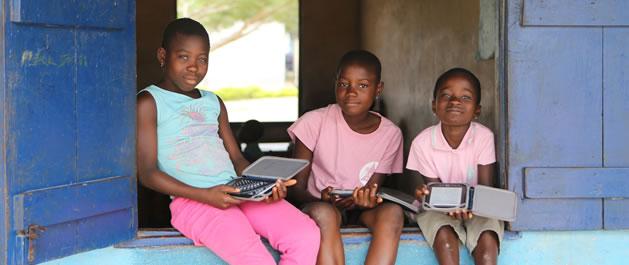
A few years ago, Kate was one of the first Ghanaian students to dive into mobile reading. Her school was part of Worldreader’s pilot e-reader program, and the students received Kindles loaded with hundreds of textbooks, local stories, reference books, international classics and other related educational material.
Kate, like many of her fellow students, fell in love with reading that year. After finishing The Shark by Ghanaian author Peggy Oppong—a book Worldreader digitized and uploaded to her Kindle, she was hooked, and magical things began to happen. Kate, 17 years old at the time, kept flipping digital pages and pretty soon powered through more than 100 books. She decided she wants to be a writer when she grew up, and has started with poetry.
I met Kate a few weeks ago, and was happy to hear that not only did she graduate high school and continues to write, she’s also sharing her love of reading. To pay forward the gift given to her, she’s volunteering with Worldreader and helping younger kids learn how to read, engaging them in activities that will make them lifelong readers and discovering ways to nurture critical thinking skills both in herself and among the children she’s working with.
Breaking the Habit of Rote Learning

Credit: Worldreader
While there is a place for rote learning in some educational situations, it’s becoming clearer every day that easy-to-use technology, such as e-readers and feature phones, are important tools that can be used to enhance learning and empower generations of children in the developing who are hungry for information.
It’s also evident that sustainability and continuity are critical cornerstones in any reading program. If there are gaps in the learning process or no way for the kids to actively participate in the give-and-take interaction avid reading requires, educators face an uphill battle in developing a literate, well-informed society.
To address those issues, Worldreader has invested in developing initiatives that set up students for reading success and encourages the ongoing use of technology-based mobile learning processes. Two such efforts are ‘Out of Classroom Experiences’ and ‘Vacation Reading School’.
Out of Classroom Experiences take the child out of the typical classroom setting of habitual repetition, and gets them involved in reading-related after-school and weekend activities. The activities, run by teachers, volunteers or Worldreader staff, complement the classroom learning experience because they’re designed to get children talking about what they read, thinking about what they read and thinking about how they think. They’re meant to spark curiosity, present alternative perspectives and provide a safe place where kids can speak out without fear, judgment or concerns about failing.
Additionally, students have an opportunity to learn how to express themselves, a skill they’ll need throughout their lifetimes both personally and professionally. This is especially important in places, like Ghana, where students are not often allowed to voice their opinion in the everyday classroom setting, for instance. This lack of expression inhibits the intellectual growth of a child.
At its most simple level, Out of Classroom Experiences are also ways for children to enjoy a good book. It’s really not much different than the book clubs we see for adults.Theykeep kids reading in their leisure time and gives them a space to interact, share ideas and go beyond what’s listed in the curriculum. It’s an enriching experience that connects the reader and the story to the world around them.
Vacation Reading School (VRS) has a slightly different purpose. We started VRS three summers ago as a way to maintain reading momentum over summer break. Unlike the Out of Classroom Experiences, VRS is a minimally-supervisedenvironment where students are encouraged to use their e-readers to read for fun. We opened the program to all students at the participating schools–to students who had been using e-readers in their classes and to students who hadn’t yet been exposed to digital reading or mobile learning. We immediately discovered how much need there was — children poured in every day and we’ve seen the program grow every year since. This summer, for instance, the average daily attendance at VRS was 175 students; the program was set up in two schools and ran for 20 days during the month of August.
We have consistently seen that children who have never used Kindles quickly picked it up by watching their friends or by trial-and-error button-pushing, and were equally excited to discover the sheer joy of reading what they wanted to read.
We’re still analyzing the results from this summer’s VRS program, but the learnings from our kick-off year exemplify how much potential there is to impact many more lives, even in relatively short amount of time during a school break.
 Linking the Chain

All around the world we are reminded of the tremendous potential that access to education has for young girls, and more broadly for a new generation of young people worldwide. Malala Yousazai`s story in Pakistan is of utmost importance in our minds as she has suffered so much in her fight for the right for access to education. Thankfully, as we are trying to demonstrate at Worldreader, greater mobile connectivity makes it both easier for young people to acquire the knowledge they need, even in the most extreme circumstances, and harder for militant or political organizations to stop them from accessing this information and education.
Since Oct. 11 is International Day of the Girl, we want pay special tribute to not only the courage of girls like Malala, who is among the favorites to win this year’s Nobel Peace Prize (winners will be announced this week, also on Oct. 11), but also to the less visible examples such as Kate. Kate’s drive, enthusiasm and dedication will inspire and empower many others to read more and better.
While Malala’s influence and strength will be felt for decades, Kate’s story proves a practical hands-on model that can be duplicated many times over globally: Give young people a chance to improve their minds and put in their hands easy-to-use devices that open the world to them, a natural force will rise up and move the reading revolution forward. One reader inspires another one, new links are built in the reading chain, and a continuous, sustainable educational cycle evolves.
Join the conversation
How can we together continue to develop sustainable reading programs that encourage lifelong reading?
What have you seen implemented at other literacy nonprofits?