
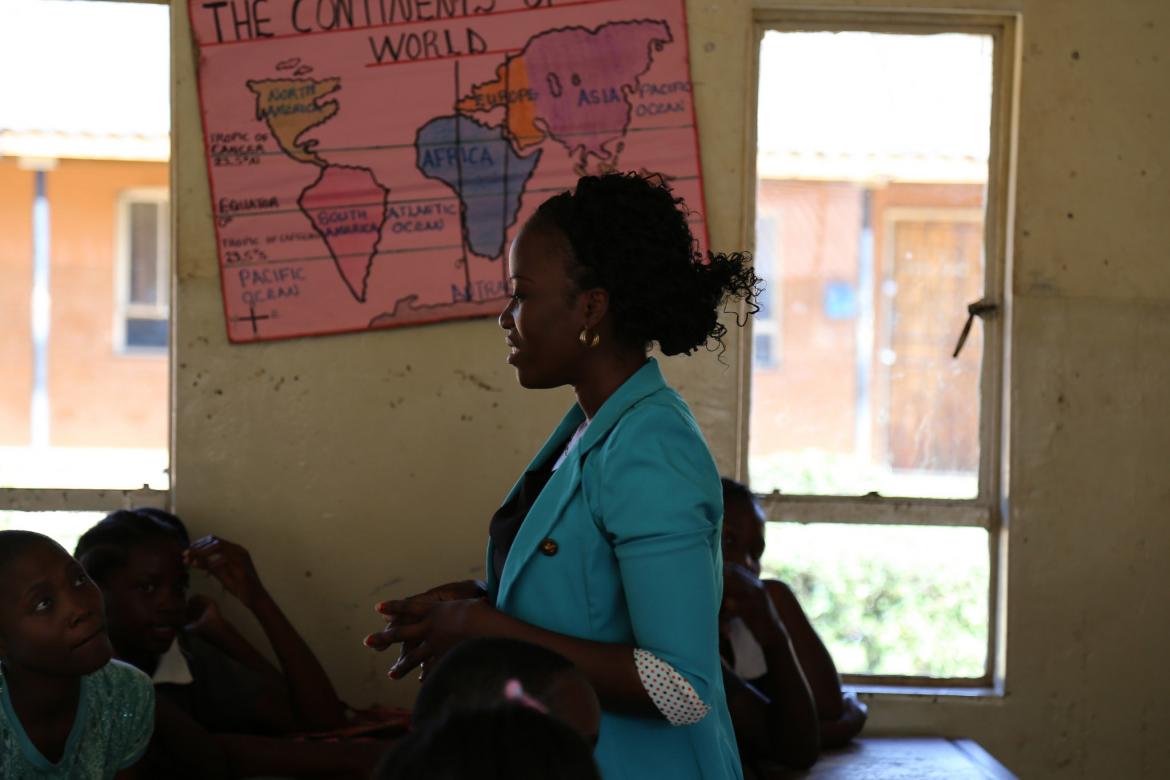
The Zambia Education Sector Support Technical Assistance (ZESSTA) facility* has been helping the Ministry of General Education’s (MoGE’s) Directorate of Teacher Education and Specialised Services (TESS) and its partners to address concerns about teacher performance through the development of national professional standards for teachers, school leaders and teacher educators.
"One of the functions of the Teaching Council of Zambia is to develop, promote and uphold national professional standards for education professionals. It has been really important to work with our colleagues in the Ministry, in the Teaching Service Commission, with private education providers and with the teacher unions to develop a first draft of the standards which we can use as the basis of a broad national consultation exercise. ZESSTA support for this project has been invaluable," said Dr. E. Mubanga, Registrar, Teaching Council of Zambia.
The challenge: uneven teacher performance
In Zambia, there are many excellent teachers, teacher educators and head teachers. But there are also concerns about underperformance, especially in government schools, where leadership is sometimes weak, appraisal arrangements are uneven, staff development is unfocused and poor behavior and attendance is not properly addressed.
The Teaching Council of Zambia was established specifically to improve the professionalism and performance of teachers, teacher educators and headteachers across the country. The Council is required to register all educators and to renew their practicing certificates every three years to confirm that standards of behavior and performance are acceptable.
The development of existing outline standards into a fully developed set of national professional standards for teachers was proposed at a joint meeting of ZESSTA, the Teaching Council and senior officers of the MoGE.
There was agreement that a single standards framework, setting out what teachers should 'know’, ‘know how to’ and ‘be able to do’, should underpin teacher education as well as teacher appointment and induction, performance appraisal, CPD and inspections, and should be the basis of the issue and renewal of practicing certificates.
Zambia’s response: developing new teaching standards
Led by MoGE, a Teacher Standards Steering Group (TSSG) was established to take forward the initiative. Its initial membership included all MoGE directors, senior representatives from the Teaching Council, the Teaching Service Commission, teacher unions and representatives from the private schools sector. The Permanent Secretary for General Education was nominated as chairperson of the TSSG given its wide remit and its importance.
At its first meeting in November 2016, the TSSG agreed a roadmap to develop national professional standards for teachers and extended the initiative to include standards for teacher educators and institutional leaders.
Following this, a workshop was held with a wider group of stakeholders to consider the value and use of common sets of standards, review examples of standards from other countries and agree the broad shape and scope of a set of standards for Zambian schools and colleges.
Following the workshop, a drafting team met in smaller working groups to develop the detailed wording of the standards. The standards framework was endorsed, with some useful modifications, by a further meeting of the larger stakeholder group.
The standards framework has six ‘areas of practice’ which capture the principle areas of responsibility of education professionals. Within each area of practice, a number of standards were described and, for each standard, descriptors were developed that would enable individuals to demonstrate that they met each of the standards.
After the development of the draft standards, the TSSG decided that an extensive and thorough national consultation exercise would be critical for successful understanding and use of the standards.
UNESCO agreed to support the proposed national consultation exercise within Zambia and offered to facilitate the alignment of the emerging Zambian standards with a common standards framework for the SADC region.
The TSSG endorsed this approach and a technical committee, supported by UNESCO and ZESSTA, finalized the draft standards ready for national consultation. This included differentiating the standards expected of education professionals who are newly appointed; at submission for renewal of the three practicing certificates; and of ‘distinguished’ professionals performing at the highest levels.
The results: adoption of the new standards
Consultation with a range of stakeholders has found that the standards are clear and will enhance performance management. Discussions with UNESCO also confirm that the structure and content of the Zambian standards are broadly compatible with an emerging common model for countries across Southern Africa; this will help shared learning when the standards are implemented across neighboring countries.
The different agencies involved in the development of the standards in Zambia, including the unions, the Teaching Service Commission, the Teaching Council and directorates within MoGE, are already developing a common approach to how the standards will be used at the various stages of the teacher, teacher educator and education leader lifecycles.
ZESSTA has worked with TESS and the Teaching Council to identify how portfolios of evidence could be maintained by headteachers to demonstrate whether they are meeting the standards and how such portfolios could be used in the periodic renewal of practicing certificates for head teachers.
In their toolkits on performance management and continuous professional development, TESS has already incorporated how school leaders can use the forthcoming standards to monitor and improve the performance of teachers.
The planned national consultation exercise will stimulate interest in the standards and how they will be used, and will provide opportunities for questions to be answered and issues to be clarified before a final version of the standards is approved.
“We don’t want to create a shiny standards booklet that looks good on bookshelves. We want the standards to make a difference,” said a workshop participant.
"I am positive that the portfolios we have developed will bring sanity in the teaching profession. I wish to thank the ZESSTA for supporting the Ministry to develop the portfolio as a way of monitoring the performance of our headteachers. This is a good move and I am sure that you shall see more well managed schools," another participant added.
Read more about ZESSTA and the development of national professional standards for Zambian teachers in our results paper.
* ZESSTA is funded by the Global Partnership for Education and UK aid and delivered by the British Council.
Comments
Does this framework look to enhance the creativity of the pupils? Does it allow for positive psychological reinforcements within the classroom? Especially with regards to how teachers teach.