
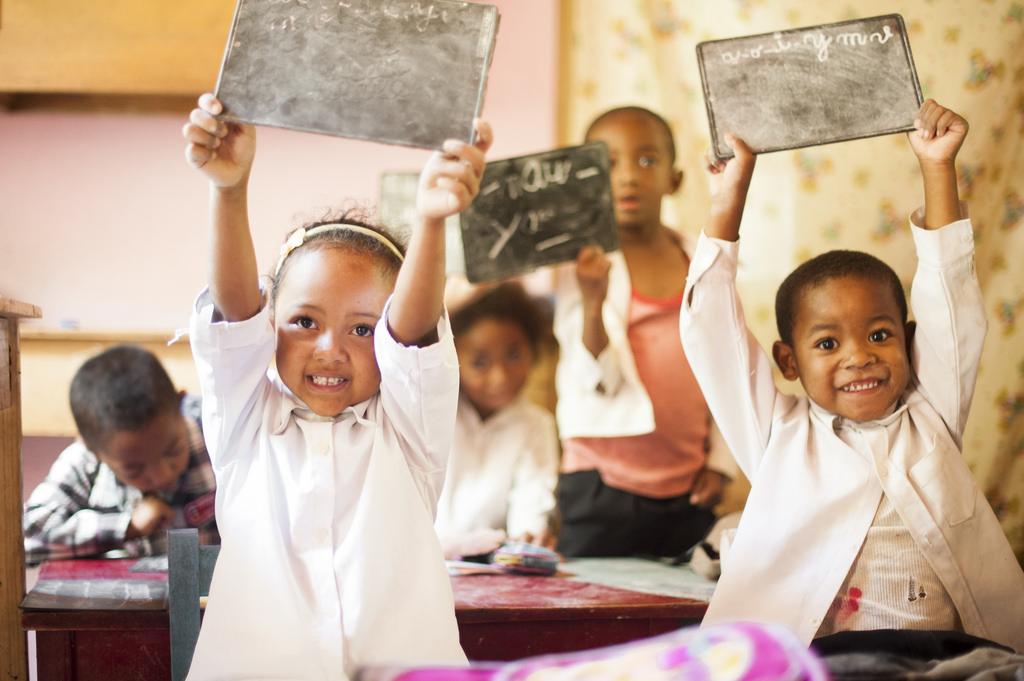
G7 leaders convened in Brussels on June 4-5 to discuss international politics. But Brussels will also be in the spotlight later this month, when the G7 countries, other donor countries, developing countries , civil society, private sector representatives and youth advocates will come together to discuss financing for education. The second replenishment conference of the Global Partnership for Education will take place on June 26 and the stakes are high: The Global Partnership aims to raise US$ 3.5 billion for 2015-2018. That level of funding will ensure that 66 low-income nations can meet the annual school costs of 29 million children.
G7 countries play a pivotal role
G7 countries have a special role to play in setting the scene. Back in 2002, the G8 were the founding parents of the Global Partnership – which started as Fast Track Initiative.
The initiative grew out of the “New Focus on Education for All” communiqué of the G8 summit in 2002 in Canada when G8 leaders pledged to significantly increase the support to basic education. It’s time that G7 leaders remember that commitment and re-focus on education.
"It is unacceptable that education slipped down the international agenda in past years and that aid to basic education is decreasing. The G7 leaders can reverse this negative trend and renew their focus on Education for All with the upcoming GPE replenishment"
More focus on the most marginalized
G7 countries should send a strong signal of support and care to those 126 million children of primary and lower secondary school age who still don’t have access to education – more than half of them are girls, one third of them live with a disability. The world must not forget the most marginalized groups, often the poorest of the poor. All children, regardless of their circumstances, have a right to good quality education.
"In most low- and middle-income countries, children with disabilities are more likely to be out of school than any other group of children. In some countries, having a disability can more than double the chance of a child not being in school, compared to their non-disabled peers"(see also “Disabled People in Developing Countries Are the Poorest of the Poor” by Alice Albright).
Germany needs to be a strong supporter
The replenishment conference of the Global Partnership is a litmus test for world leaders to prove their commitment for Education for All and their willingness to back their promises with financial resources.
Germany as one of the G7 countries will be in the spotlight at the replenishment. The government has recently recommitted to support education in development cooperation. The coalition agreement as well as new political guidelines for the cooperation with Africa highlight education is a key area. Germany’s Federal Minister for Development Cooperation Dr. Gerd Müller has announced to increase support to education to € 400 million annually. However, the contribution to the Global Partnership for Education stands only at around € 7 million annually. The replenishment will be a first test for the German government to see if the promises will be backed by increased funding for the only global multilateral partnership for education.
Comments
I believe the image of a child as being capable, competent, curious and creative learners. They are natural explorers and researchers. Each child has different level of learning style, the children learn through all their senses and therefore it is important that we exercise a curriculum that is flexible to suit each child’s needs and interests as thus fostering the development of the whole child. From their very early age children start collecting information from their surroundings, be it parents, educators or other children. However, to covert this information into knowledge, we need education.