
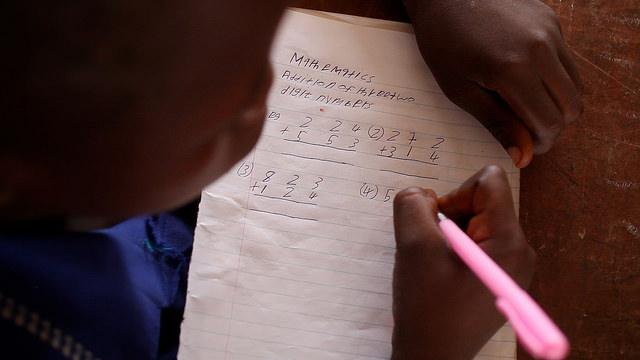
Please join us for our April numeracy webinar where Dr. Daniel Ansari, at the Department of Psychology & Brain and Mind Institute, will present recent research that has shown that basic number processing (such as comparing which of two numbers is larger) is related to individual differences in children’s arithmetic achievement. Furthermore, children with mathematical disabilities (developmental dyscalculia) have been found to perform poorly on basic number processing tasks.
In this webinar, Dr. Ansari will review evidence for an association between basic number processing and arithmetic achievement in children with and without mathematical difficulties. Dr. Ansari will draw on evidence from both brain and behavior and discuss the implications of this research for assessment, diagnosis and intervention. Dr. Ansari will also discuss quick and easy to administer screening tools that can be used in a diversity of educational settings to capture early, individual differences in foundational numerical abilities. Check out more information about the test at: http://www.numeracyscreener.org/.
Daniel Ansari received his PhD from University College London in 2003. Presently, Daniel Ansari is a Professor and Canada Research Chair in Developmental Cognitive Neuroscience in the Department of Psychology and the Brain & Mind Institute at the University of Western Ontario in London, Ontario, where he heads the Numerical Cognition Laboratory. Ansari and his team explore the developmental trajectory underlying both the typical and atypical development of numerical and mathematical skills, using both behavioral and neuroimaging methods. He has a keen interest in exploring connections between cognitive psychology, neuroscience and education and currently serves as the President of the International Mind, Brain and Education Society (IMBES).
To access the webinar:
|
In advance to the webinar Please make sure that webex runs on your computer and you can get audio access! For that you can do a ‘test meeting’ on the webex website: http://www.webex.com/test-meeting.html You might need to install ‘JavaScript’. To check whether you have the appropriate players installed for UCF (Universal Communications Format) rich media files, go to https://nethope.webex.com/nethope/systemdiagnosis.php |
|
Webinar access To start or join the online meeting, go to https://nethope.webex.com/nethope/j.php?MTID=m89fffa2a9380413a105823abdbd897e7 Audio access: Please call one of the following options: Please mute your audio during the webinar presentation to avoid background noise. You will receive instructions on how to mute your microphone by accessing the webinar. To participate in the discussion, we encourage you to unmute your audio or share your questions and comments in the chatbox. |
|
For assistance: On the left navigation bar, click "Support". For assistance or if you have any problems with the login please send an e-mail to: numeracy@giz.de To add this meeting to your calendar program (for example Microsoft Outlook), click this link: https://nethope.webex.com/nethope/j.php?MTID=m935e56f7e4eda7c5a4cf91bf3584fbd9 IMPORTANT NOTICE: This WebEx service includes a feature that allows audio and any documents and other materials exchanged or viewed during the session to be recorded. You should inform all meeting attendees prior to recording if you intend to record the meeting. Please note that any such recordings may be subject to discovery in the event of litigation. |
Become a member of the Numeracy Community of Practice!
The webinar series is part of a Community of Practice (CoP) ‘Numeracy for Development’, facilitated by the GIZ , Save the Children, and Creative Associates. The CoP is open to teachers, educators, practitioners, researchers, academics and others interested in numeracy. To join the community of practice, visit this page.
For further queries and information, please contact us at numeracy@giz.de