
Preparing a robust education sector plan
In South Sudan, the Ministry of Education, Science and Technology (MoEST), supported by its partners, is continuing the arduous work of preparing its next education sector plan (ESP). This is especially challenging in a country emerging from conflict, having immense development and humanitarian needs, and being faced with an economic crisis owing to high inflation and the global collapse in oil prices.[1]
The proposed ESP will define the major educational priorities and targets for the government over five years (2017-2021) after expiration of the current General Education Strategic Plan.[2] Three workshops have been held already (in February, March, and April 2016), with all groundwork to conclude by July 2016.
Civil society’s commitment

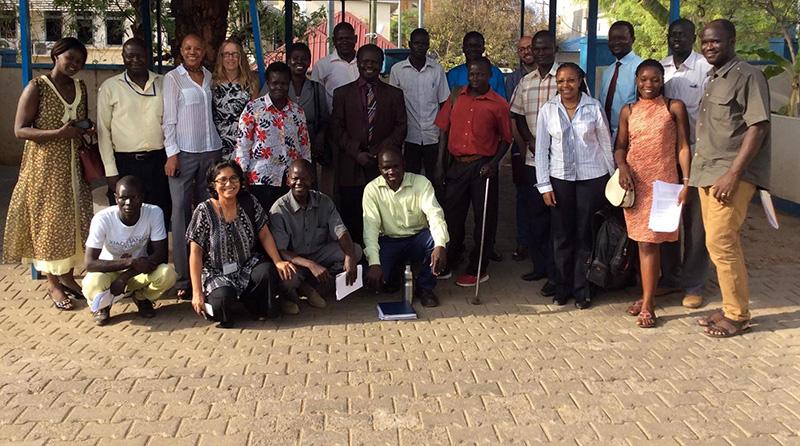
Ministry of Education, Science and Technology, a multi-ministerial national team, and education partners at the South Sudan Education Sector Plan Workshop on Thursday, 17th March 2016.
Photo Credit:United Nations Educational, Scientific and Cultural Organization
The Partners for Education Group (PEG), a new civil society education forum in South Sudan, was welcome to participate in three out of four ESP working groups, namely, access (including alternative education system), quality, and management—the 4th working group covers technical vocational education & training and higher education.
PEG was also involved in the 2nd South Sudan Education Sector Analysis, which is linked to the current ESP development. In collaboration with an array of national and international actors, this was a first time for coordinated mobilization and representation of civil society within these processes.
PEG members share key lessons
At the March ESP workshop, four PEG members were asked to share one key lesson or idea that they have drawn from the ESP processes or that they thought was important in the development of the ESP. Below is what they had to say.
Emelia Luka (Organization: Hold the Child)
“I participated in the management group. We were looking at three objectives: (1) improving effective and efficient communication, information flow and coordination in education between national, state, counties, payams (or towns), and schools; (2) improving monitoring and evaluation of education programs in South Sudan; and (3) strengthening the Education Management Information System (EMIS).

Salah Khaled, Head of Office and the United Nations Educational, Scientific and Cultural Organization Representative to South Sudan (left) and Ministry of Education, Science and Technology Undersecretary Michael Lopuke Lotyam (right) at the launching of the 2nd South Sudan Education Sector Analysis on Monday, 5th October 2015.
Photo Credit: United Nations Educational, Scientific and Cultural Organization
Our group discussed information flow from all levels, assessing structures, capacity levels and reporting tools, also the importance of developing a communication strategy through the MoEST Information Communication Technology office. It is important to develop a strategy to have a roadmap and sensitize staff about the strategy at all levels.
For EMIS, we identified a challenge: the system is only operational at the national level. Therefore, we looked at ways that it could be decentralized across states.”
Condition Emmanuel Enosa (Organization: Light for the World)
“One key lesson for me is the participants’ diverse perceptions about involving and engaging persons and learners with disabilities in mainstream education and development programs in the country. Most participants were optimistic that learners with disabilities will learn even better in inclusive mainstream schools, through support from assistive learning devices and teachers with appropriate, inclusive education training.
Although inclusive education in South Sudan seems to be an imported ideology to tackle discrimination, isolation and trauma associated with the education of learners with disabilities, many communities and education stakeholders lack essential information especially on the United Nations Convention on the Rights of Persons with Disabilities. Therefore, in the next ESP workshops, I plan to advocate for the sensitization of communities on inclusive education, for example, through educational institutions at national, state, and county levels.”
Rubaya Monzur (Organization: BRAC)

PEG members Charles Alfred Watuwa (Standing, 2nd Left, Beige Shirt), Emelia Luka (Standing, 5th Left, Black, Red, Brown, and White Blouse), Rubaya Monzur (Front, Black and White Blouse), and Condition Emmanuel Enosa (Front, Yellow Shirt) after being selected to represent the Partners for Education Group in the 2016 South Sudan Education Sector Plan Working Groups.
Photo credit: Partners for Education Group
“Currently, in South Sudan, examination after the secondary four (S4) level is taken through a centralized system whereas examination after the primary eight (P8) level is the responsibility of state education ministries. So the examination papers vary from state to state and students’ achievements are not comparable across states. Considering this, our quality group focused on a national examination system that will conduct the examination at the end of P8 and S4. This type of examination could be a formal summative assessment, which could be comparable across states and time.”
Charles Alfred Watuwa (Organization: Humane Aid for Community Organization)
“In the quality group, we also discussed at length the idea of an in-service teacher training program using modules to be reviewed twice a month with the help of an assigned tutor, to be followed up by a rigorous two-week face to face at a teacher training institution or county education center. This idea was proposed as a way to promote the quality of teachers, and, in turn improve the quality of education among learners without compromising the responsibilities of teachers.
Regarding ways to attract women in the teaching profession, we looked at incentives in terms of accommodation for student teachers who are mothers and their baby sitters, lower cut off grades for females intending to undergo teacher training and scholarships for academically-excelling female students.
I stressed that psychosocial sessions should be incorporated in schools to support students affected by trauma, in order to improve their ability to learn. Also, that teachers should be taught on how to set credible test items that meet accepted standards and that career guidance should be introduced into schools to guide learners on identifying what they wish to be later in life.”
For their contributions in this blog, special thanks is extended to PEG members Emelia Luka, Condition Emmanuel Enosa, Rubaya Monzur, and Charles Alfred Watuwa.
Comments
Having interacted with PEG in the past, I am impressed by contributions the group is making to education sector in South Sudan. Securing this chance to input into the ESP that will shape education in South Sudan for the next five years is a great plus for the Civil Society. This is just one of the many initiatives I know you are taking up in the country. I like the coordination, I like your working relationship with government and I admire your synerigies! Keep going.
I do appreciate all efforts about second Education Sector (2017-2021) for South Sudan, I have read the First Sector 2012-2017 and I noted that; the sector did not pay much attention to Information and Communication Technology (ICT).
ICT is the fundamental of global requirement; and according to UNESCO (2009) Guide to Measuring ICT in Education:
1- All educational institutions (Universities, Colleges, Secondary Schools and Primary schools) should be connected with ICT.
2- ICTs shall be integrated into all primary and secondary schools curricula .
3- Individuals should have increased ICT skills to benefit fully from the information society.
I hope in the second sector of education planning, Integration of ICT shall have a place.
Peg members we need to do more together with Education Sectors to help improve our education systems. Thanks to leadership of PEG and GPE for this block. Emelia
PEG is our pride in the development of the education sector in South Sudan, members please keep in there if we are to make a difference. Thank you PEG representatives to the Education Sector plan for the good work you have done with your contributions.
Ador and Team, we are sure you will take PEG to another level as we work with the Ministry of Education to enhance the quality of education delivered in schools.
Congratulations to PEG members for the good effort put in here. We at ANCEFA are confident that your contribution, with midwifing the Education coalition within 2016, will go a long way in helping South Sudan enable its citizens to realise the right to Education
You have our full support
I would like to congratulate all PEG members and the leadership of Portia and Ador for this engagement in the ESP.The development of the Education Sector Plan once completed will be a clear win for south sudan,the ministry,teachers and ultimately the children of this country.keep on the great work that you are doing.
I am really humbled to have been part of this great team that did South Sudan such noble cause of finding solutions for the welfare of the innocent Child. God protect this nation.