
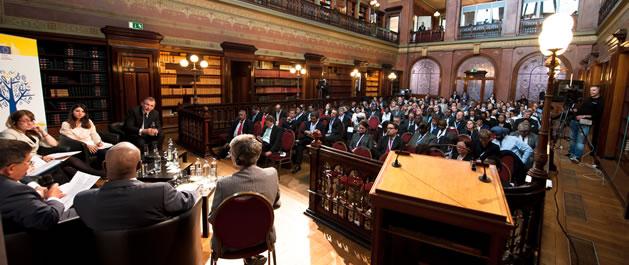
EU conference reinvigorating the momentum for education
The European Union (EU) is standing up for education. Andris Piebalgs, EU Commissioner for Development, hosted an EU High-Level Conference on Education and Development on May 23 in Brussels. It was a day full of lively debate and inspiring reflections on education calling for a stronger global movement and pressing for progress in getting children in school and giving them the opportunity to learn – especially in the most difficult contexts.
“We are right to champion education, because of the immense power it has to change lives for the better,” said Commissioner Piebalgs underlining the transformative power of education.
Education ministers from partner countries, several EU Commissioners, representatives of EU member states, civil society, youth representatives, academics and other development partners explored current challenges to equitable, quality education and how we can overcome them. They also reflected on the place that education takes on in the broader context of national development goals and in the global development framework post 2015.
Overcoming challenges to equitable, quality education
The right mix of experts, practitioners, decision makers and youth representatives inspired a rich debate and encouraged participants to think outside the box. The tenor was that we need to find new and innovative ways to address the problems, and challenge our very assumptions. As Princess Laurentien of the Netherlands argued, perhaps we need to learn from marketing to make education more attractive and use technology to provide children and adults with learning opportunities they need.
Education plays a critical role in state building and ensuring a peaceful transition from conflict. Schools are often the first signs of normalcy that communities see after a period of crisis. But education in emergencies is often not prioritized and poorly funded in global humanitarian assistance. And yet, we know that education can be that crucial link between humanitarian and longer- term development. Building the capacity of countries to provide education is a long- term priority that we must continue to address with the leadership of governments and national partners.
Communities must play a central role in long-term solutions. Governments need to engage communities to increase their sense of ownership of their schools, to make sure their children attend school and do not drop out and to ensure local accountability for what happens at school.
The critical role of teachers came up repeatedly throughout the day’s discussions. Schools need good and motivated teachers. Children will only stay in school if the teaching is relevant and engaging. And, of course, we need to measure learning outcomes.
The role of education in the post- 2015 development framework
We must continue to work on the unfinished business of getting all children in school, because there are still 61 million children of primary school age who are not in school. An additional 250 million children either drop out of primary school or leave without the basic skills of literacy and numeracy. There’s a lack of teachers, and not enough learning and teaching material, school buildings and classrooms. The list goes on.
The concerns are universal. Illiteracy, for example, is not only an issue for developing partner countries. Low levels of literacy are also a concern in Europe and other high-income countries.
Going forth, we need new ideas and have to bring in new actors from outside the education sphere. Youth representatives argued that education needs to meet the needs of young people and stressed the importance of non-formal education for today’s youth. They need to be equipped with life skills to master the challenges of today’s world. The business sector should be seen as a partner in development who can contribute to solutions.
We also need a simple global framework which enables countries to adapt the goals and set targets based on national priorities. Recognition of education as a fundamental human right should underpin any new framework.
The need to support national priorities emerged throughout the conference as essential. One way to do this is to work with global partnerships such as the Global Partnership for Education and the New Deal to back country level reforms. There remains a shortfall in education financing both at global level and in country budgets. UN Special Envoy for Global Education, Gordon Brown, warned that, “even in a time of austerity, now is not the time to cut support to education. This would be the most short-sighted thing to do”. A goal for education will mean nothing without funding.
The role of the European Union
In his final remarks, Commissioner Piebalgs reiterated that the EU will maintain strong support for education within the post-2015 international development framework, focusing on improving equity and quality with significant funding through global and country programmes, including increased involvement in and support for the Global Partnership for Education.
The EU will also continue championing aid effectiveness and align support with national education plans. At country level the EU will focus even more on local needs and priorities and will continue to work with other partners on a coordinated approach seeking lasting results and greater resilience of education systems. We will also provide adequate education to help implement policy.
Living up to the expectations of millions of children and adults all over the world – while copying the motto on the wall of a showcased school project in Somalia – the Commissioner closed the conference by stating that “we must be able to say that we did our bit to make education unlock the golden door of freedom”
For more information, including a recorded version of the live webcast, please see the conference website