
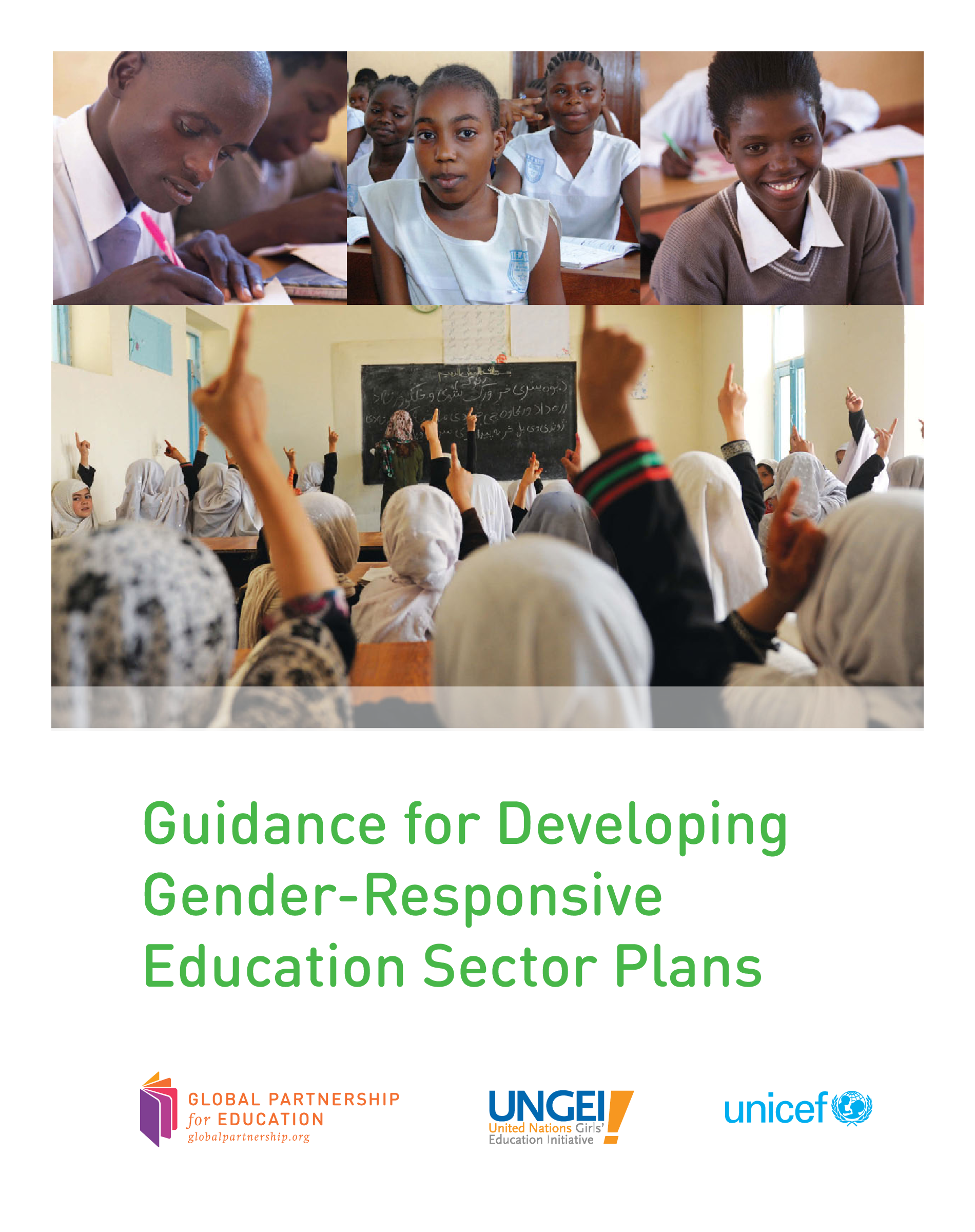
The Guidance developed by GPE and UNGEI, with support from UNICEF, has been designed to help deliver on the commitment of the Sustainable Development Goals and Education 2030 to achieve gender equality in education. The tool will help developing countries put in place gender-sensitive policies, plans and learning environments, with a view to transform the way education systems function.
Applying a gender lens to education analysis ensures that policies and strategies can better target specific groups of girls or boys and the challenges they face.
Why does gender matter in education ?
The 2000 Education for All (EFA) Framework for Action states that “gender-based discrimination remains one of the most intractable constraints to realizing the right to education. Without overcoming this obstacle, Education for All cannot be achieved” (Dakar, 2000). Fifteen years later, although the context has changed, attention to gender issues remains a key component of the global agenda.
At the 2015 World Education Forum in Incheon, Korea, representatives issued a declaration reaffirming the vision of EFA initiated in Jomtien in 1990 and reiterated in Dakar in 2000. The Education 2030 declaration articulates a continued vision of achieving inclusive and equitable quality education and lifelong learning for all. This vision explicitly recognizes the importance of “gender equality in achieving the right to education for all” (Incheon, 2015). The Sustainable Development Goal (SDG) confirm and amplify the strong connection between gender equality and education; SDG Target 4.5 specifically calls for the elimination of gender disparities in education and equal access for all, and the broader 2030 Agenda for Sustainable Development goes further to underscore the centrality and mutual dependence of education and gender equality.
Achieving gender equality requires a rights-based approach that ensures that girls and boys, women and men not only gain access to and complete education cycles, but are empowered equally in and through education.
In spite of great progress since 2000, gender-related barriers continue to combine with other socioeconomic barriers to prevent girls and boys (and women and men) from accessing and benefiting from quality education and learning opportunities. In many countries, girls are disproportionately excluded and disadvantaged in education; in others, boys underperform and drop out at higher rates than girls. And within and across countries, multiple social, economic and structural factors impact which girls and which boys are most marginalized. For example, gender inequality may be particularly marked in rural or conflict-affected areas, among the poorest households, or for children who have disabilities or are members of an ethnic minority. Looking across multiple exclusion factors such as these is critical in order to identify which children are most disadvantaged and respond accordingly.
Gender equality is a critical piece of the broader picture of equity and inclusion in education, as well as in society at large, and will be achieved most effectively when combined into a comprehensive and unified commitment to leave no one behind. When we can successfully provide quality education to the girls and boys that have been excluded, the payoffs are considerable. Research shows that gender equality and girls’ education has a dramatic and positive impact not only on the girls themselves, but on their families, communities and society more broadly. Understanding and addressing gender issues in all areas of education—from the quality of learning experiences to achievement and aspiration for the future—is key to achieving the global commitment to “ensure inclusive and equitable quality education and promote lifelong learning opportunities for all.
Download the full report below