
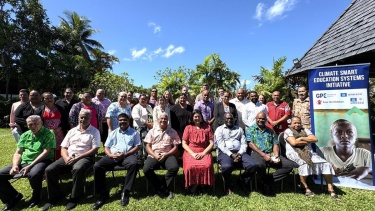
Participants of the Climate Smart Education Systems Initiative Regional Coordination and Climate Finance Workshop held in Nadi, Fiji, in March 2026.
Education leaders, development partners and technical agencies have called for stronger finance investment to help Pacific schools become more accessible, stronger and safer to the impacts of climate change.
At the conclusion of the three-day Climate Smart Education Systems Initiative workshop in Nadi today, Pacific Heads of Education Systems Chair, Wayne Mendiola, stressed the need for coordination, continued integration of climate into education priorities, planning, adequate resourcing and technical assistance to access climate finance in the education sector.
The Pacific is one of the world’s most climate vulnerable regions, where extreme weather events continue to disrupt learning, damage school infrastructure, and threaten children’s right to safe, continuous education. Schools across the region are already experiencing the impacts of cyclones, floods, sea level rise and heatwaves, risks that are projected to intensify.
The regional dialogue highlighted priority thematic tracks being identified for future climate resilient education investments and a practical roadmap developed to support a greater investment in climate finance to strengthen schools across the region.
The Pacific Heads of Education Systems chair stated: “As Pacific leaders, we know that climate change is not a distant or abstract challenge. For us, it is a lived reality. Rising seas, stronger cyclones, floods, droughts, and heat are already disrupting our schools, our teachers, and our learners. These impacts threaten not only infrastructure, but also learning continuity, student wellbeing, and hard‑won education gains.”
“This workshop is not about creating a new regional mechanism. Rather, it is about informing and strengthening existing regional coordination arrangements, particularly PacREF, so that climate‑resilient education work is better aligned, more coherent, and more useful for countries” he added.
GPE Country Engagement Lead for the Pacific region, Florian Rabenstein encouraged all participants to use the workshop to strengthen coordination across ministries and regional mechanisms such as PacREF to ensure that the Pacific could better unlock and leverage climate finance for education: “We look forward to learning from your experiences and working together to build strong, equitable, climate‑smart education systems for every child in the Pacific.”
Elke Puritau, Pacific Regional Director - Program Operations for Save the Children Australia said that while many countries were advancing ambitious climate education work, accessing finance remained a challenge for most: “Over the final two days, we will strengthen our understanding of the global climate finance landscape, learn from each other’s challenges and successes, and identify the key priorities the region wishes to pursue in future climate finance funding proposals. This work is essential if we want to move from commitments to concrete, resourced action.”
#####
Media contact:
- Kristyn Lobendahn, Pacific Regional Communications Lead, @email
Note to editors:
The Climate Smart Education Systems Initiative is a regional program designed to strengthen the resilience, safety and continuity of education systems for up to 14 countries across the Pacific.
Supported by GPE and implemented in partnership with Ministries of Education, Pacific Heads of Education Systems, UNESCO and Save the Children, the Initiative provides countries with technical assistance, climate data and practical pathways to access climate finance.
It also provides practical support to governments to make their school systems climate resilient.
The $1.8 million investment supports evidence-based planning and policy development and embedding climate resilience into local curricula.
The Initiative is aligned with regional priorities under PacREF and the emerging Regional Good on Climate Change Resilience, ensuring Pacific countries have the support needed to build future focused, climate ready education systems.
Participants of the Climate Smart Education Systems Initiative Regional Coordination and Climate Finance Workshop held in Nadi, Fiji, in March 2026.