
Building a stronger partnership to improve education in Cambodia

The joint sector review process in Cambodia is engaging and constantly evolving, which contributes to strengthening the partnership in the education sector.

by Aya Kibesaki, GPE Secretariat, and Yuliya Makarova, GPE Secretariat
|
5 minutes read
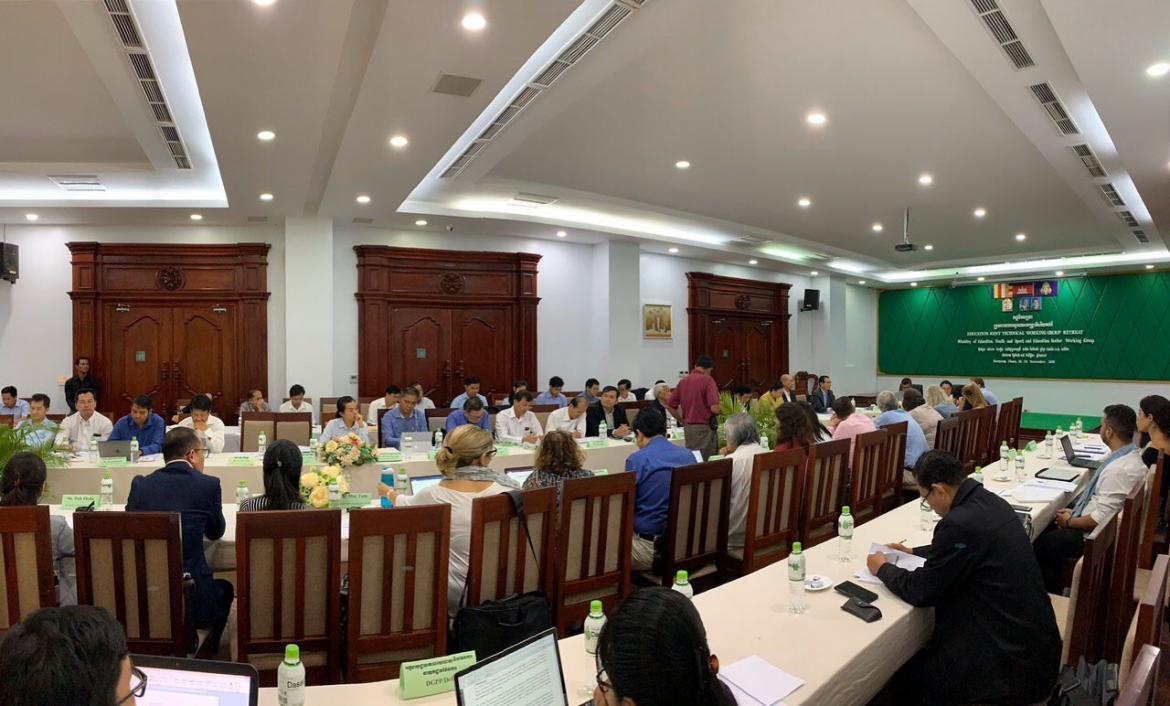
Cambodia's joint sector review meeting. Credit: Yuliya Makarova

Cambodia's joint sector review meeting.

Credit: Yuliya Makarova

A joint sector review (JSR) is a government-led process bringing education stakeholders together to monitor and discuss progress and ways forward for the implementation of national education sector plans.

JSRs are a key component of GPE’s operational model through promoting strong in-country collaboration and partnership to support ministries of Education provide better education for all.

Cambodia’s JSR process is quite unique among GPE partner countries. The highly engaging and constantly evolving process consists of various types of dialogues and meetings held annually.

Each year, the Ministry of Education, Youth and Sports (MoEYS) in Cambodia organizes a three-day long Education Congress for all ministry personnel, which provides a national platform to reflect on education sector progress and challenges, and to make recommendations. Around 1,500 teachers, district and provincial education officials, and development partners discuss the way forward with reference to the annual progress report (“Congress Report”) prepared and shared by the ministry.

The joint sector review builds on the Education Congress and relies on quarterly meetings of the local education group, called the joint technical working group for education (JTWG), to monitor its workplan. A 2.5-day retreat of the JTWG serves for in-depth or thematic discussions around key challenges.

Looking back

Last November, the GPE Secretariat participated in the JTWG retreat. The meeting focused on three elements:

  • reflecting on the challenges and progress achieved in 2019
  • lessons learned during the implementation of the previous education sector plan
  • discussing priority issues and reforms outlined in the new education sector plan covering 2019-2023.

As in other years, the retreat was co-chaired by Dr. Hang Chuon Naron, Minister of Education, Youth and Sport and by Cristian Munduate, Vice-chair of the local education group and UNICEF representative.

The annual education retreat in Cambodia has constantly been evolving, adapting its structure and methodology to improve the quality of dialogue and collaboration between local education group members.

The themes covered included an education trends analysis; enhancing education quality by improving teaching quality; expanding school-based management from primary to secondary schools; financing the new education sector plan; and a new equity-focused school funding formula and other education inclusion and equity issues.

Discussions on equity issues covered a variety of aspects and perspectives through three parallel working group sessions – including special and inclusive education, multilingual education and gender equality. The smaller group setup facilitated free and vibrant exchanges between participants on how to reach the most disadvantaged children.

Cambodia’s progress in promoting inclusive education

Over the past years, MoEYS has made strides in improving access to inclusive and quality education: the ministry is implementing a policy on inclusive education; has designated a department within the ministry to provide oversight on inclusive education matters, and recently established the National Institute for Special Education, which provides teacher training on special education and manages five special education schools for children with disabilities - previously run by NGOs.

However, challenges remain relating to the provision of inclusive education services, including a lack of accurate data on students with disability and a comprehensive diagnosis system, a limited referral system and support services, and a shortage of qualified human resources.

During the retreat, participants discussed viable solutions and immediate needs such as adopting comprehensive disability screening and a referral process to enhance coordination between ministries; the need for a feasibility study to better map resources and services; and the need for an assessment of learning outcomes of children with disabilities.

Multilingual education: Progress and challenges

The five north-eastern provinces of Cambodia are home to 24 indigenous ethnic minorities groups, representing around 1.5% of the population. These groups speak their own languages and often have a more limited command of Khmer - the national language.

Given that Khmer is the language of the state school curriculum, these groups are often excluded from mainstream education. Finding effective solutions to provide access to inclusive and quality education for a relatively small percentage of the population is a challenge, but Cambodia is making significant efforts to ensure that every child can fulfill their right to education, whichever their ethnicity.

In this context, Cambodia has adopted multilingual education (MLE), where children are enabled to learn using their mother tongue from preschool and in the early years of primary school, with a gradual transition to using Khmer for learning in class.

Although MLE was originally started on a small scale with NGO support from CARE, the program has expanded across the five north-eastern provinces. This expansion was guided by the multilingual education national action plan 2015-2018, which was successfully implemented.

Future expansion will be guided by an action plan to be implemented from 2019 to 2023. A significant factor in the expansion of the program, and its ongoing sustainability, was the ministry’s agreement to cover the salaries of MLE teachers.

The program is having a positive impact.

There is significant community involvement in MLE schools, and MLE students are learning better than other students in math and have similar results in Khmer to other non-MLE students.

At the retreat, participants discussed scaling up MLE provision and improving its quality. Recommendations included implementing the MLE action plan; expanding MLE provision including non-formal education; improving the quality and retention of MLE teachers and reviewing MLE curricula.

Addressing trends on gender inequality in lower secondary education

Over the last few years, Cambodia became one of several countries in the region where more girls than boys are completing lower secondary school. Although the improvement in female completion rate is a positive development for girls’ education more broadly in Cambodia, the growing gender gap due to the decline in boys’ completion is becoming an increasing concern.

During the retreat, UNICEF presented initial findings from small-scale qualitative research examining factors affecting boys in their decision to drop out of school, and several policy solutions adopted by other countries to address similar trends were discussed to provide a useful reference.

Identifying key priorities for moving forward

Dr. Hang Chuon Naron and Cristian Munduate concluded the retreat by proposing specific policy solutions and action strategies.

The Minister reiterated the need to continue to work on teacher development – a major education reform priority. Linked to this work is the need to develop a system to support the continuous professional development for teachers and school directors, including a teacher career pathway, to incentivize the quality improvement of pedagogy.

He also presented concrete strategies for the effective implementation of the Education Strategic Plan 2019-2023, including the incorporation of multilingual teacher training in one of the provincial teacher training centers; creating courses and developing student career counselling services to reduce dropouts at the secondary level, particularly for boys.

Ms. Munduate reiterated the importance of the successful partnership between the ministry and the local education group and the urgency in addressing some of the identified challenges.

In her concluding remarks, she reminded everyone that “What we cannot do for our children today, we cannot repair tomorrow” referring to the high price countries pay for missed education opportunities.

Related blogs