Making education financing more efficient: What GPE partner countries are committing to do

GPE partner countries are making important commitments for the period 2026-2030 to make their education budgets work better by improving their efficiency. See examples from 22 countries.

by Stefania Sechi, GPE Secretariat, and David Bruns, GPE Secretariat
|
6 minutes read
Grade 1 students show their drawings to their classmates during a lesson at Chambak Haer Primary School, Puok District, Siem Reap, Cambodia. Credit: GPE/Roun Ry

Grade 1 students show their drawings to their classmates during a lesson at Chambak Haer Primary School, Puok District, Siem Reap, Cambodia

Credit: GPE/Roun Ry

In many countries, education budgets face growing pressure from fiscal constraints, competing priorities, and rapidly expanding student populations. Yet, education systems are expected to do more: expand access, improve learning, support teachers, and reach the most vulnerable learners.

In this context, increasing resources is often difficult in the short term, and making effective use of existing resources becomes more important than ever.

Efficient financing is about maximizing the impact of every dollar invested in education. It means putting the right policy in place and ensuring that resources reach classrooms, are allocated where they can have the greatest impact, and help students learn and progress successfully through school.

Strengthening teacher management, improving procurement systems, reducing financial leakages, and addressing repetition and dropout can all improve learning outcomes, sometimes requiring only marginal additional spending.

In some cases, these reforms can also free up resources that can be reinvested in priorities such as teaching, learning materials, and student support.
Making education financing more efficient: What GPE partner countries are committing to do

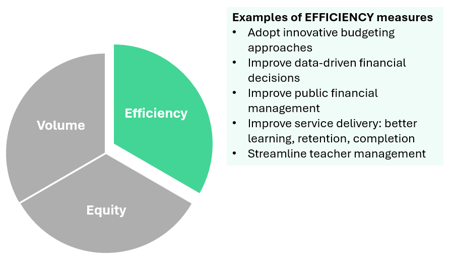
Acting on two fronts for efficiency gains

Governments can improve the efficiency of their education spending on two fronts.

First, they can focus on making the system work better, by reducing waste and ensuring that resources are managed and used effectively. This can include, for example:

  • adopting innovative budgeting approaches like performance-based financing.
  • improving public finance management systems with better governance, coordination, digitalization, streamlining of procurement and improved school-based management.
  • enhancing education and finance data systems for better budgeting and planning.

Second, they can focus on getting better results for every dollar spent. This means improving the delivery of education services so that investments lead to stronger learning outcomes, higher completion rates, and lower repetition, and identifying and scaling the most cost-effective interventions.

Actions can focus on:

  • improving the delivery of education services to improve learning, thus also improve retention and completion rates.
  • streamlining teacher management and remuneration mechanisms, recognizing that teachers account for the largest share of education spending and that evidence consistently shows that effective teaching is one of the strongest drivers of student learning.

In May, we presented examples of partner countries’ commitments on the volume of domestic financing to education for the period 2026-2030.

Now let’s turn to the efficiency elements of these pledges. The examples below are a small sample of the detailed pledges received from 48 partner countries.

Innovative budget approaches

  • Bhutan is developing a per-child costing model for non-salary expenditures (teaching materials, utilities, maintenance). The model will be integrated into annual budget cycles starting this year and ensure transparent, needs-based, and equitable resource allocation across schools.
  • Burundi is rolling out performance-based financing for schools and decentralized services. The idea is to condition resources on concrete results to improve the system’s efficiency and strengthen accountability.
  • Guinea is implementing training and capacity building for actors in the budget execution chain, from central to decentralized levels. These initiatives are expected to improve public expenditure execution rates, reduce delays in disbursement and increase the overall efficiency of education financing.
  • Lesotho is decentralizing planning and budgeting processes, following capacity building of district education officials. The country plans to further decentralize to the school level, including training school principals on producing the annual School Development Plan. It is also introducing a new information management system (DHIS2 for Education) to accurately track learner participation and resource allocation.
Making education financing more efficient: What GPE partner countries are committing to do

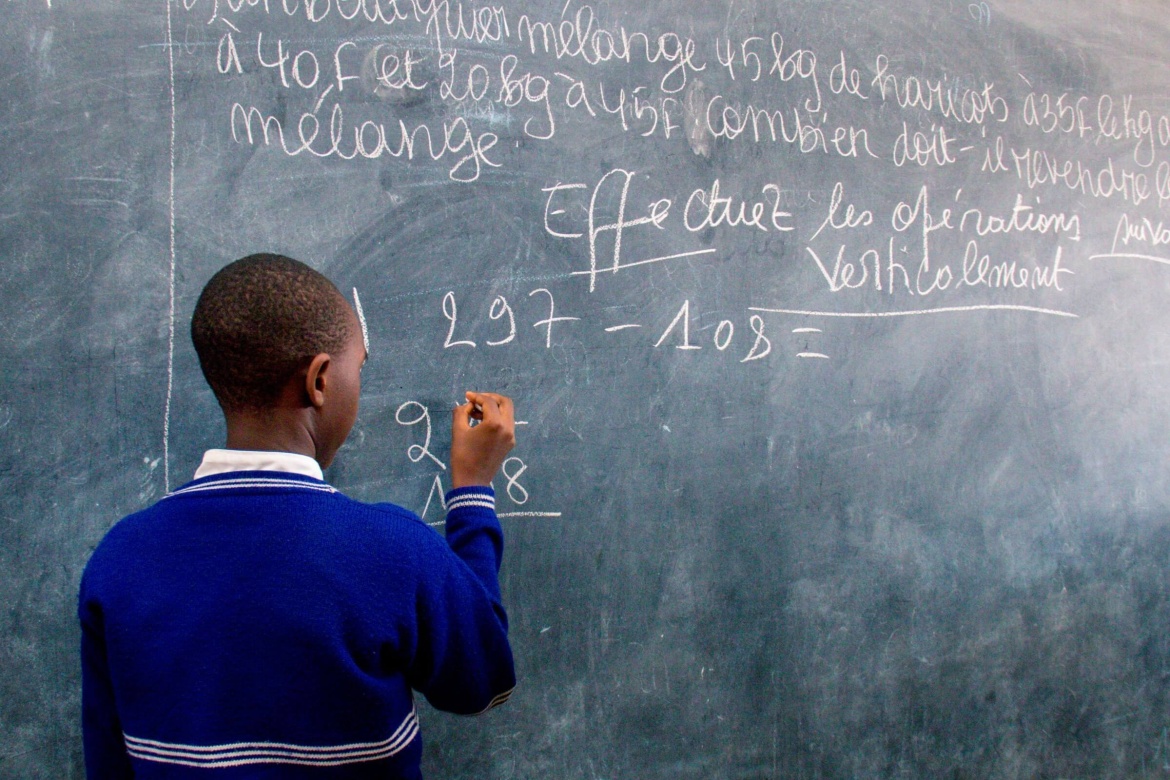
A student solving a math problem in class. Kigobe Reference Center for Inclusive Education, Bujumbura, Burundi.

Credit:
GPE/Ingomag

Improved governance and data management

  • In Cambodia the Ministry of Finance is strengthening implementation of the Financial Management Information System and expanding its implementation to the Ministry of Education to improve data management, reporting, and availability for planning, budgeting, and monitoring in the education sector. The country is implementing the Teacher Policy Action Plan 2024-2030 to strengthen pre-service training, expand continuous professional development, and prioritize teacher motivation.
  • Eswatini has introduced program-based budgeting through their data system with a revised Chart of Accounts to enable tracking of expenditure from national to local level.
  • In Malawi, the Integrated Financial Management Information System (IFMIS) ensures that expenditures are recorded and monitored in real time. This reduces opportunities for off-system spending and improves the traceability of public resources.
  • In Nepal, the integration of budgeting, costing, projection, and simulation tools into the Integrated Education Management Information System (IEMIS) strengthens local governments’ capacity to link plans with budgets and execute them effectively.
  • In Niger, the Ministry of Economy and Finance is giving the education ministry access to its BOOST Database, which will help the education ministry stay on top of financial execution throughout the system, as well as produce statistical yearbooks and implementation reports. The country is strengthening its pooled fund for education (FCSE), operational since 2018.
  • Pakistan Sindh is planning to integrate the School Management System and IFMIS through application programming interfaces (APIs) and to perform periodic data import and export. This integration will ensure consistency and accuracy of data across systems and enable visibility from planning to execution. The change is expected to significantly strengthen teacher deployment and transfer mechanisms, needs-based allocation and budget execution, and overall education service delivery.
  • Rwanda will use the revised Imihigo public service performance contracts for teachers and head teachers, incorporating metrics on teaching and learning outcomes, and tying this to their salary bonus. A new teacher performance evaluation system measures Presence in the classroom; Preparation (of lesson); Pedagogy; Participation in the Comprehensive Assessment Management Information System; and Performance of learners as measured by learning assessments and national exams.
  • Senegal is in the process of allocating subsidies to school management committees to develop tutoring strategies and reduce dropouts and repetitions. The country is enhancing its EMIS through digitizing school data collection and the interoperability of platforms; it has also established a Joint Monitoring Committee (COSCAB) as an instrument for strengthened dialogue with the ministries of finance and economy.
  • Sri Lanka is adopting procurement reforms and centralized purchasing to reduce costs and delays. It is also strengthening monitoring and evaluation mechanisms to track results and value for money, and ensure interventions are not simultaneously planned or financed through multiple sources.
  • Tajikistan is leveraging the EMIS database to monitor resource allocation at the school level. This use of data allows to identify and rectify disparities between urban and rural educational institutions. The country is also engaging with parent-teacher associations and civil society in overseeing school budgets.
  • In Uganda, the education ministry is implementing an e-inspection system once a term for primary and secondary schools to ensure adherence to minimum standards and teacher effectiveness.
Making education financing more efficient: What GPE partner countries are committing to do

Grade 4 students do group work under the watchful eye of their teacher, Boboeva Kurbonbi, at school 51 in the town of Kulob, Khatlon Region, Tajikistan.

Credit:
GPE/Kelley Lynch

Strengthening delivery of education services and teacher management

  • Burkina Faso will deliver psychosocial support and develop education alternatives to ensure continuity of education in areas affected by conflict as well as provide locally sourced school meals, including via school gardens and farms, to ensure students stay in school.
  • Chad plans to train community teachers in teacher training institutions for a period of 2 years.
  • Madagascar plans to provide teachers and school directors with various continuing and certifying trainings in line with their career path, and to evaluate teachers' skills regularly.
  • Mali is modernizing teacher management through an Integrated Human Resources Management System and a National Teacher Policy, including by creating teacher performance dashboards and setting an equity-based formula for allocation of teachers that will favor the most disadvantaged regions.
  • Marshall Islands purchased a special software to manage its teachers digitally and systematize a previously manual and paper-based processes resulting in significant increases in efficiency of teacher management.
  • Sierra Leone is cleaning up the biometric teacher payroll system to improve its integrity, efficiency, and transparency.
  • Zanzibar is using a Teacher Allocation Protocol, which ensures that teachers are assigned to primary schools with the highest needs. The use of the national sector plan and its results framework align partners, strengthens national planning, budgeting, procurement, and monitoring systems, improves coherence in implementation, and enables systematic tracking of resources and results.

#####

Read other blogs in this series

Related blogs

Leave a comment

Your email address will not be published. All fields are required.

The content of this field is kept private and will not be shown publicly.

Comments

  • No HTML tags allowed.
  • Lines and paragraphs break automatically.
  • Web page addresses and email addresses turn into links automatically.