
Ear Infections Shutting Kids Out of School and Impairing Learning
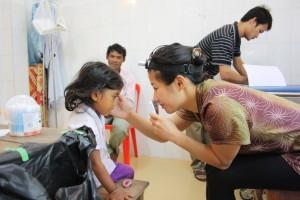
The face of the little Cambodian girl lit up when the doctor was finished cleaning her ears. She moved her head side to side smiling, clearly amazed at what she could hear. The girl regained approximately 30% of her hearing on the spot, and was given a course of antibiotics to help fight the infection.
Prior to this treatment the first grader had been diagnosed with 65% hearing loss due to an untreated ear infection. Hardened ear wax had stuck in her ear like a cork making it practically impossible for her to hear a teacher in the noisy classroom. Her treatment – removal of blocked wax, and pressure-cleaning the infected mucus out of the ear – was very simple, but necessary to reverse the problem. It caused a bit of discomfort, but she was very brave, not moving an inch. She was among the “lucky” few. Her hearing loss was temporary, and it was discovered early enough to prevent further damage.
I remembered this story from a GPE-funded disability data collection project after I read the new global estimates on prevalence released by the World Health Organization (WHO) last week on the International Ear Care Day. The report estimates that more than 360 million people in the world have disabling hearing loss, a shocking number making the Cambodian girl just one of millions.
WHO states that “infections of the ear are the leading cause of hearing loss with approximately 32 million children under age of 15 affected. Infections of the ear are the leading cause of the disability, especially in low- and middle-income countries. Half of all cases are easily preventable, while many can be treated through early diagnosis and suitable interventions…”
It’s amazing how a number, even if it is only an estimate, can alarm us, make us pause and pay attention. It definitely caught my attention: 32 million children. We may know about a problem, but a number helps us to grasp the magnitude of a problem. The lack of data on the other hand can keep a problem invisible.

© GPE/Natasha Graham
What is an ear infection?
We all know that young children get sick, and an infection in the ear is a very common childhood illness. Most of us have had it as children. Ear infection or otitis media originates in a small space behind the eardrum in the middle ear, which is normally filled with air. It’s connected to the back of the throat by a tiny tube. When a child is sick with a cold the middle ear space can fill with fluid, and become infected.
Ear infections come with a few common symptoms such as a dull ear ache fever which usually last for a few days. There are two “must-haves” that make the infection go away: a strong immune system, and/or access to a doctor who can diagnose and prescribe a medication. In low-income countries, very few children have strong immune systems, and even fewer have access to even basic health services. This can turn something as simple, and easily treatable as an ear infection into a major problem affecting 32 million children under the age of 15.
Imagine a child sitting in the classroom with a persistent ear ache, unable to hear everything the teacher is saying. If the problem does not improve, that child may stop going to school.
What do ear infections have to do with children’s education?
First of all, ear infections are painful. And that pain alone can prevent a child from participating in school. If infection goes untreated for a long time, a child may develop a hearing problem. And if low-hearing is not addressed, then a speech impairment may follow.

A hearing doctor performs an impacted ear wax removal procedure on a child whose ear canal is blocked by hardened ear wax trapping infected mucus inside.
© GPE/Natasha Graham
Imagine a child sitting in the classroom with a persistent ear ache, unable to hear everything the teacher is saying. If the problem does not improve, that child may stop going to school. The child may or may not return to school, and he or she might need additional support to catch up and learn. That additional support is costly, complicated and rarely makes it to the top priority list of policy makers. At best, the child will be labeled as a “slow learner” and turn into an education statistic that’s often left unaddressed. The child has become invisible.
The availability of a number, a global estimate took my mind back to a rural health center in Cambodia where a little over a year ago – as part of GPE-funded disability data collection project – Cambodian children were medically screened and treated on the spot treatment or referred to a hospital.
Many of these children were diagnosed with some form of untreated ear infection. None of them had previously been seen by a doctor. Some had already dropped out of school. Officially, it was never noted that an ear infection might have been the reason for dropping out. Some of the kids might not have listened or paid attention to the teacher, were perceived to have a “behavior problem,” or just missed too many school days. Others might still be in school, but struggle to keep up with the work. All of them had a common, but previously undiagnosed problem: an untreated ear infection.
Because of overwhelming demand additional hearing specialists or ear doctors had to be brought in to address the great number of children who needed to be treated.
We know that there are millions of children out there who will benefit from and require similar, low-cost, but high-impact interventions. We now even know there are approximately 32 million children with hearing loss, and about half are preventable. The question is – What do we do now that we know?
We hope you’ll get involved in helping children learn and grow, and join our conversation on Facebook and Twitter.