
Early childhood education in Lao PDR
It was near noon, when we arrived at the Khoke Hae village school in the district of Sangthong about two hours from Vientiane, the capital of Lao PDR. The school director greeted us and invited us to an open patio shaded under a large tree. The cicadas were buzzing, and we could hear children’s voices coming from the classrooms surrounding the courtyard.
After meeting the school director we visited the grade 1 classroom. Grade 1 is usually the first exposure to formal learning for children in low-income countries. But the truth is – learning does not start with grade 1. The purpose of our school visit was to see the two pre-school classes attached to that primary school. These pre-school classes are amongst just a handful of pre-school programs in Laos.
Community involvement in schools is crucial
These two pre-school classes were built by the community. The windows were still shaded with aluminium sheets and colourful curtains, but the classes were well attended. There were about 20 children between 4 and 5 years old in each of the two classes. Parents brought lunch for the children. Some went home, but most preferred to stay and eat and play with others. The children were curious. They peeped through the partition when we moved from one classroom to the other. They greeted us all in unison, sang songs and demonstrated circle games in response to the cues from the teacher.
Children want to learn – early on
All children are born ready to learn. Their brains are pre-programmed to develop skills and neurocircuits depending on the experience they receive. Children’s readiness to learn refers to the child’s ability to meet the demands of school such as being cooperative, sitting quietly, taking turns, and listening to the teacher.
Whether Early Childhood Development (ECD) is delivered in a formal or non-formal setting, in centres, in homes or playgroups, through parental education or women’s groups, they share in common that significant adults are in touch with children. These adults, usually parents, caregivers or teachers mediate between the children and their environment and watch and help them in their wholesome development. We now know from developmental biology that children’s brain development depends on the early experiences including nutrition, infections and nurturing interactions like sensitive, responsive and language interaction with caregivers. Young children develop through social interactions.
They learn through play. Foundations of numeracy and literacy are built through their interactions with the environment and each other.
Literacy skills are acquired long before grade 1, beginning at birth through every day interactions like talking, singing, sharing books, telling stories, or pointing out and naming objects.
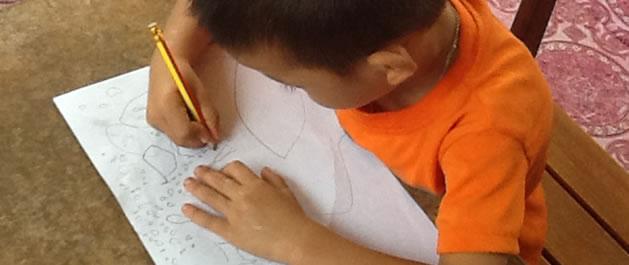
Painting, drawing, or picking up things help develop hand muscles and coordination, which are skills necessary for learning how to write. Songs, nursery rhymes and stories help pre-schoolers develop early literacy skills through letter-sound relationships and word recognition.
Likewise, numeracy begins with the understanding of a 3-year-old that she is taller than her 1-year old brother. Relationships between objects (big-small, long-short, etc) are the foundations of numeracy. The ability to use number sequences is a pre-requisite for addition, subtraction, multiplication and division. These skills are developed before they start formal school.
Language develops in the early years of a child
We know from neuroscience that language develops early and depends on experiences in the early years. Vision and hearing develop before language and language develops before cognition. Development problems in early life will influence language and cognitive development.
As such, early childhood development programs are well positioned to:
- Prevent disabilities from arising;
- Detect early warning signs, screen and identify those with developmental delays;
- Determine whether a child has a disability and respond appropriately;
- Assist children with disabilities growing up in a meaningful manner;
- Keep children with disabilities within mainstream society.
GPE supports early childhood development
Increasingly, GPE countries recognize the importance of ECD programs and add pre-school classes to regular primary schools. Some countries invest in developing non-formal pre-schools based in homes or community centers such as the community based school readiness centers or playgroups in remote areas in Laos.
We will continue to work with our developing country partners on creating synergies between primary and pre-primary education so we can leverage children’s learning achievements.
Education can be a great equalizer but only if all children get an equal chance to take advantage of it.
A child who is hearing impaired because of frequent ear infections, will have less chance of receiving the auditory inputs necessary for her language development. Thus investing in ECD and preventing disabilities from arising is key to ensuring children’s healthy development. Providing young children today with early experiences that are healthy and enriching will give them the roots and wings they will need to be the dreamers, builders and leaders of a better tomorrow.
We hope you’ll get involved in helping children learn and grow, and join our conversation on Facebook and Twitter.