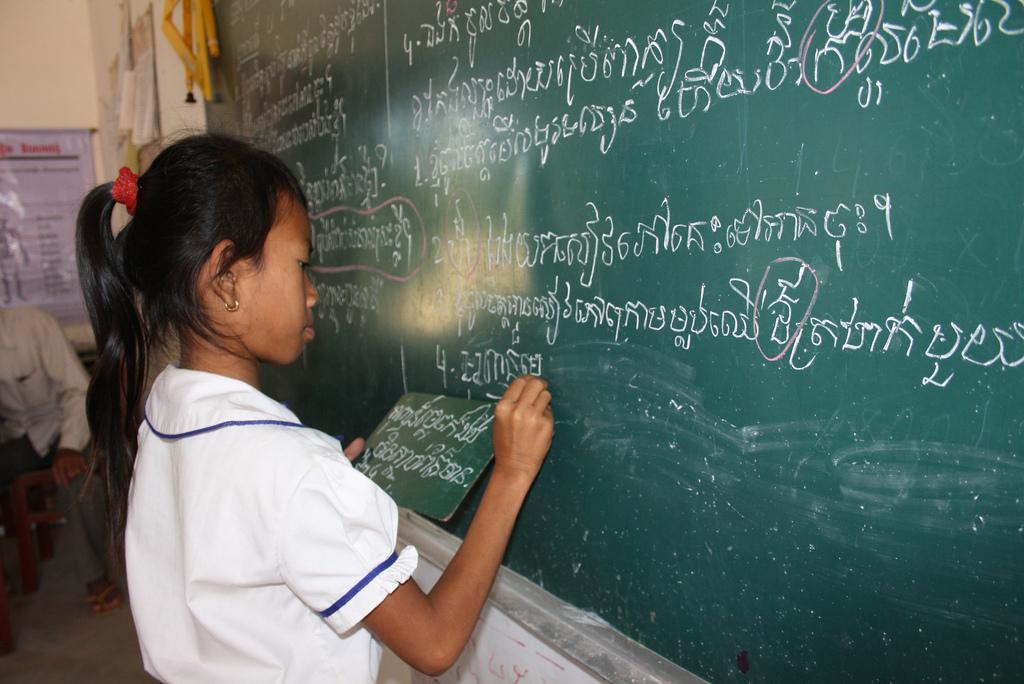
UNICEF reports that more than 333,000 children are born with HIV every year. Seykeo Meas, age 8 and in grade 1, is one of these children.
Born in Phnom Penh, Seykeo contracted HIV from her mother, who is no longer alive. Seykeo currently lives with her grandmother.
Seykeo, whose favorite subject is math and wants to be a teacher when she grows up says she enjoys coming to school. Her teachers and classmates, she says, “like me, and understand when I am sick and miss school.”
When Seykeo is sick, her teachers and school administrators make sure that she gets lessons, or homework, sent to her house so she can keep up with the curriculum. However, there are also times when her condition escalates and she has to spend days in a hospital to recover. Even though she falls behind in the curriculum from these prolonged absences (currently she is two grade levels behind from her cohort), the school administrators and teachers do not give up hope on Seykeo. A school administrator told me, “it’s not her fault she has HIV, so why should her education be jeopardized? Our goal is to provide her to an education, so she can take care of herself when she grows up. Until then, she has us. And, she has her Grandmother.”
I got a chance to meet with Seykeo at her primary school in Phnom Penh. Looking at her innocent face and eyes, she didn’t look like a child struggling with HIV. Instead, she looked like a student eager to learn and be with her classmates, like the other children at the school.
And, when I visited Seykeo’s classroom, I could tell she was an equal, and not discriminated against because of condition. When we walked in the class together, some of her friends came up to her, and asked, “who is the Indian lady with you?” She introduced me to her classmates and friends, showed me her desk, and also demonstrated a group activity with her classmates.
The support system provided to Seykeo by her school is extraordinary. The Global Partnership, among other organizations, reports that many children drop out of school because they are HIV positive, or have AIDS. These children generally struggle because they fall behind in school, due their sickness absences, and then eventually drop out.
Using Seykeo’s experience as an example, other schools can learn how to support children with HIV or AIDS. They can help them stay in school, make sure they can read, write, are numerate, so that their illness is not an obstacle for future opportunities.
Through the work on out-of-school children, children with disabilities, and girls’education, the Global Partnership is working with marginalized children, like Seykeo, to make sure they have the opportunity to receive a quality education they deserve and achieve their aspirations. For Seykeo, we hope that she achieves her dream of becoming a teacher when she grows up.
I’m HIV Positive, but I Still Go to School
In Phnom Penh, Seykeo, an 8-year old who contracted HIV from her mother, attends school regularly and is considered an equal among her peers.
by Deepa Srikantaiah, World Learning
|
3 minutes read