
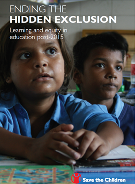
New Save the Children report about children’s ‘hidden exclusion’ from education
A new report from Save the Children, Ending the Hidden Exclusion, offers a detailed assessment of the challenges facing global education. One of the report’s key arguments is outlined for GPE by four of the reports leads authors: Desmond Bermingham, Director of Education Global Initiative, Save the Children International; Gerd Hanne Fosen, Director of Education, Save the Children, Norway; Dan Stoner, Associate Vice President, Education and Child Development, Save the Children US and Will Paxton, Head of Education Policy and Advocacy, Save the Children, UK.
Finance and education ministers from countries with the most of out-of-school children recently met in Washington DC to discuss how to respond to the global learning crisis that has left millions of children out of school or excluded from learning because they don’t have qualified teachers or they simply can’t understand what is going on in the classroom. At a separate event, also in Washington DC, Gordon Brown led a discussion on The Final Sprint to 2015 – Delivering Quality Education & Learning for All. As Alice Albright, head of GPE rightly said, this was an important week for global education. There were lots of inspiring words and plenty of fine commitments.
What the children of the world need now is action
In Save the Children’s contribution to these meetings - ‘Ending the Hidden Exclusion’ – we have published our analysis of the underlying causes and the long term impact of denying yet another generation of children their right to a decent education. We have drawn on the knowledge and experience of Save the Children experts and our partners in over 100 countries to assess the impact on education of shifts in global trends: ageing populations (everywhere, apart from Africa); growing economic inequities (everywhere, including Europe and North America); shifting centre of political gravity (from west to east and from north to south); and the continuing blight on children’s lives of conflict and natural disasters (in Syria, Mali, Pakistan, Afghanistan and many other places).
Almost everywhere we looked we saw that poor children and those from marginalized, rural communities were losing out most. Just look at the graph below based on some excellent analysis by Nicholas Spaull and Stephen Taylor from Stellenbosch University on the gaps in literacy achievement between the richest and poorest children in ten countries in Africa.

Poor children are hit hardest
The achievement gap between the richest and the poorest children in Malawi, Namibia, Zambia and Uganda is equivalent to nearly a full year of schooling. The Africa Learning Barometer found that 53% of poor children and 43% of children from rural areas were not learning basic literacy and numeracy skills. A Young Lives study on mathematics achievement in Ethiopia found that being poor, living in a rural community and having uneducated parents were by far the most important factors creating learning gaps.
For too many children, the lottery of their birth determines their education future.
The gaps start to grow early. Look at this graph of 3- 4 year olds receiving pre-primary education in 10 African countries:

In nine out of the ten countries, fewer than one out of ten children from poor families get access to pre-primary education whereas in Ghana nine out of ten children from the richest quintile receive some form of education before they start primary school. This is a clear sign that parents value early childhood education and, when they can afford it, are prepared to pay to give their child a head start. There is a growing body of evidence to show that investment in good quality early childhood education in low income countries has a high return to investment later in the child’s life. It is an extremely effective way to counter education and income inequalities by ensuring that children are better able to learn once they start school.
We cannot afford excluding poor children
We simply cannot afford to continue to waste our most valuable resource – young people – by failing to tackle the obvious exclusion of out-of-school children and the hidden exclusion of children that are in school, but not learning. In many countries, we are going backwards in learning. Inequity is getting greater not smaller. Many parents are choosing to send their children to fee-paying private schools because they are frustrated at the poor quality of free public schools. For many low-income families this means struggling to find money on a daily basis to pay the fee at the door. For the very poorest this is simply not an option and so they are further excluded.
The implications for the global education community are clear.
We need a relentless focus on raising overall levels of education AND reducing the achievement gap between the richest and the poorest.
We need to ensure that we have clearly disaggregated data which allows us to track the gap between the achievement of the poorest and the richest children. (The GMR team’s proposals on the WIDE tool are a great start here). We need to make sure that this data is made available to parents, communities and local civil society organizations so that they can hold their own governments to account. We need to ensure that poor children are given high quality early childhood education and start school ready to learn. And we need to make sure that education is a part of all humanitarian and emergency responses.
In difficult financial times, we need much better targeting of domestic resources as well as aid so that we ensure value for money and can achieve clear results from all of our investments. Reaching the poorest children – including the poorest children in middle- income countries – will be more difficult and more expensive. But the costs of failing to educate a fifth of the world’s children will be far higher. We need to act now to end the hidden exclusion and close the gaps between rich and poor.
By Will Paxton
We hope you’ll get involved in helping children learn and grow, and join our conversation on Facebook and Twitter.