
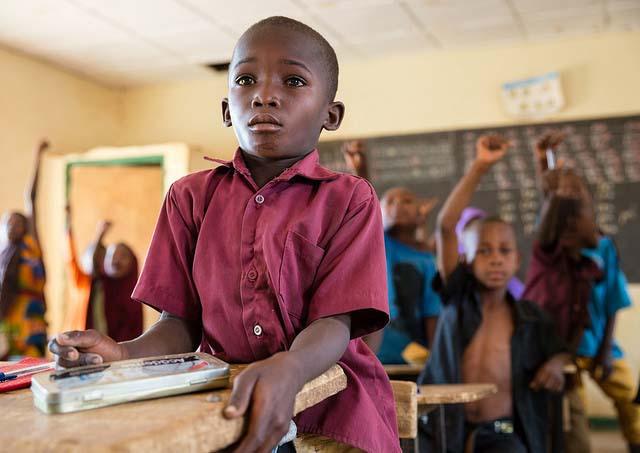
The scaling up of Norwegian support to education has resulted in education opportunities for more than 3,1 million girls and boys per year from 2013 to 2016, a new report shows. The GPE is one of Norway’s main channels of support and an important partner in global education.
In 2013, the Norwegian government announced that it would double its aid spending on global education and take an active role in global efforts to ensure quality education for all.
Subsequently, Norway increased its aid to education from NOK 1,7 billion in 2013 to NOK 3,2 billion in 2016. In 2017, support will be increased to NOK 3,4 billion, which means that the goal of doubling support to education over four years will be achieved. Norway has also doubled its support to GPE in the same period.
The new report Rising to the challenge. Results of Norwegian education aid 2013 – 2016 documents the actions taken and results achieved. It highlights results in specific countries as well as in prioritized, thematic areas such as education in emergencies.
Results of Norwegian education aid
The report shows that Norwegian education aid in 2013-2016 has contributed to:
- Over 3,1 million girls and boys supported in education each year, including 1.6 million in countries affected by fragility and conflict.
- 11 million students provided with learning materials and over 8,5 million textbooks distributed.
- 140,000 teachers trained.
- Over 5,400 classrooms constructed/refurbished in countries affected by fragility and conflict.
- In 2016, Norwegian aid to education in emergencies increased by 150%.
Mobilizing global efforts
Norway has actively contributed to the development and implementation of the UN sustainable development goals, particularly goal number 4 on education.
It has sought to strengthen the UN’s leadership in education through support to UNICEF and UNESCO, and teamed up with the UN Special Envoy for Global Education, Gordon Brown, in bringing together world leaders to discuss global challenges in education and to strengthen the business case for investing in education. The Education Commission and its report The Learning Generation – Investing in education for a changing world is a result of this effort.
Funding to GPE has doubled
Rising to the Challenge also includes a section that discusses how the collaboration with GPE has developed, with particular reference to responses to the Evaluation of Norwegian Multilateral Support to Education conducted in 2015. It notes that key recommendations from the evaluation have been followed up on, including a strengthened focus on the quality of learning, improved in-country processes and putting in place a robust results framework.
Norwegian funding to GPE has doubled in the reporting period, resulting in Norway providing 11% of all GPE funding between 2013 and 2016. The allocation planned for 2017 is NOK 590 million (approximately US$75 million), a NOK110 million increase compared to 2016.
As a percentage of the total Norwegian funding to education, GPE’s share has remained at around 17% as the Norwegian development budget has increased in the last few years.
Lessons learned and reflections
In partnership with local and international advocates and through high-level engagement and larger investments, Norway has contributed to a refocus on joint action for education, in particular on support to education in emergencies. Although much has been achieved, there is no time for complacency.
It is of concern that the share of aid for basic education going to low-income countries continues to drop, from 29% in 2014 to 23% in 2015 (UNESCO, 2017). More and better-allocated international funding is needed, and all countries must continue to increase domestic revenues and the share going to education.
Norway has been particularly successful in bridging the humanitarian response and longer term development in education. Examples of this include contributions to the GPE’s accelerated funding facility. However, there is a risk that international responses bypass government systems and hamper overall coordination. In line with the commitments from the World Humanitarian Summit, Rising to the Challenge also highlights that humanitarian short-term funding remains a challenge as regards to predictable and longer-term action.

The report also reflects a shift in focus from access to quality of learning in the reporting period. New efforts have been made in critical areas such as curriculum reform, teacher development and learning materials.
In line with Norwegian policies on concentration and effectiveness, there is also a clear shift towards investing more through global funds and multilateral partners such as the GPE and UNICEF, and to strengthen collaboration with Norwegian NGOs. Only a small part of Norwegian official development assistance (ODA) is disbursed as budget support directly to governments.
Knowledge and experience will provide the foundation for informed decision-making in the future. Continued efforts are needed to improve data and streamline information management systems so that results can be reported and sound investments can be made. In this respect, GPE will continue to play an important role.
We hope Rising to the challenge will be a valuable source of insight in the continuing efforts to achieve sustainable development and education for all.
- Read the report Rising to the challenge