
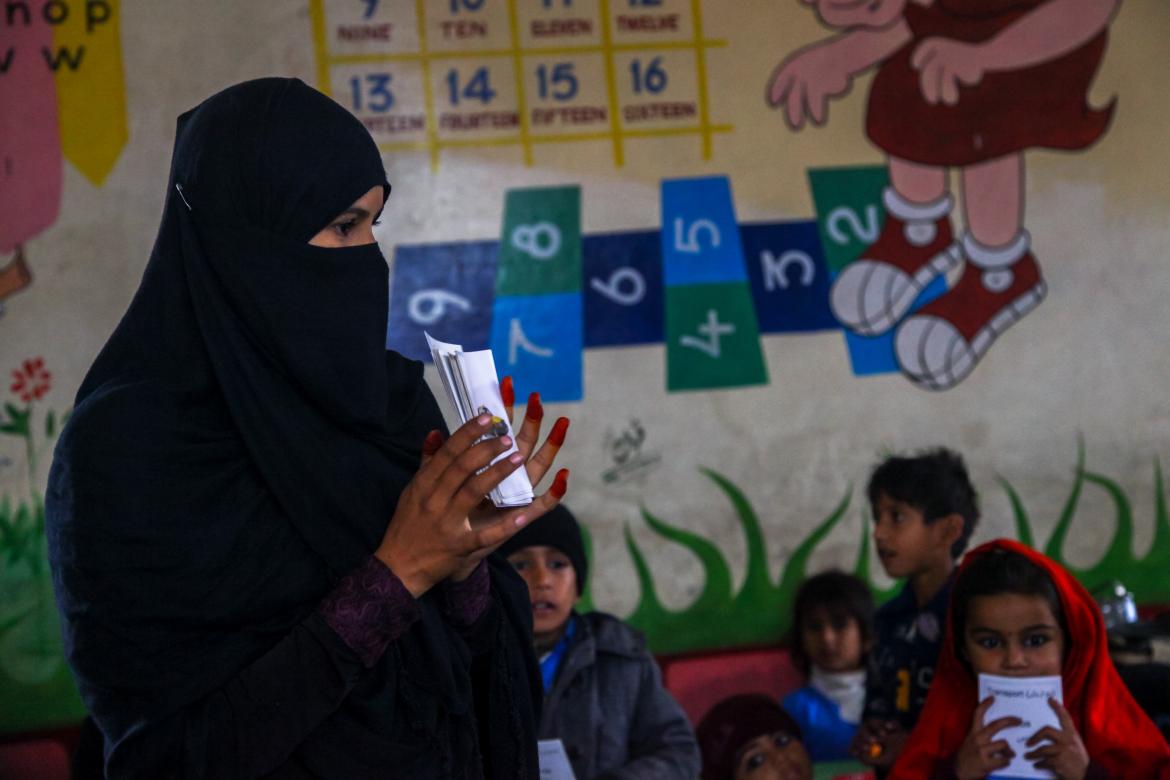
Early childhood education and development has received tremendous attention in the context of developing countries in the last decade, albeit not always matched by required resources and systems. Early childhood (0-8 years) is a period of intense and sustained bursts of development, which only comes once in a lifetime, and if one misses it, there are some sobering long term consequences for life outcomes: long-term earnings, productivity, and the ability to contribute to a sustainable world.
In recognition of its value, early childhood education (ECE) has increasingly been made a priority in country-driven sector policies, plans and laws, and has also for the first time been comprehensively placed in the global development agenda (SDG 4.2) adopted by the UN member states.
Despite global and national level commitments, hundreds of millions of children worldwide are being denied their right to achieve their full potential. Often, adverse early experiences start before birth and span the early years when children are the most vulnerable and dependent on adults, communities, and societies.
Framing the notion of setting a school entry age
In relation to other factors central to child development, age of entry to an ECE program merits consideration as un-evenness of age has implications for completion and transition from pre-primary to primary level. In any country, pre-primary school entry age is well-defined in the ECE policy and reflects the age considered to be appropriate for following a formal program with an agreed package of care, and early learning development standards that reflect the agreed ECE curriculum.
However, the understanding and research into the relationship between age, school readiness and school entry is still nascent and hence entry age threshold is found to be often relaxed, enrolling children who may be under-age (younger than 3) and/or over-age (older than 5/6).
Whilst a multiage pre-primary classroom may allow greater flexibility, it is extremely challenging for teachers and caregivers to respond to a diverse and wide range of learning, physical and socio emotional needs. Additionally, being younger or older within their peer group of children aged 3-5 creates an initial disadvantage in physical and cognitive maturity that intensifies as they transit to the primary level.1
Compounding this problem is the issue of workforce preparation, particularly in resource-poor contexts where teachers are more likely to miss out on adequate and relevant professional development opportunities to effectively tailor instructions to children’s development.
It is against this context that our new brief “ECE Age Variations and Implications for Workforce Development in Punjab” aims to open up a critical discussion about the pre-primary entry age and the corresponding workforce preparation.
The data was collected in September 2017 from a small sample of 139 ECE classrooms in Punjab (one per school) across four districts of Muzaffarhgarh, Chiniot, Bahawalpur, and Rahimyarkhan. The districts were selected on the basis of percentage ECE enrollment, presence of both state and non-state actors and our prior experience of working in the districts.
The brief provides policymakers and other stakeholders with a review of age demographics of children enrolled in ECE classrooms in Punjab as well as the current status of ECE workforce education and preparation.
Number of children and teachers surveyed by district and school type

Summarizing the multi-age patterns of entry into pre-primary
Almost every country has official guidelines on age of entry into pre-primary and primary school. However, in practice, deviations from the prescribed rules continue to occur, where children are seen to be enrolled into early childhood much earlier or later.
Figure 1 illustrates the age-range patterns of enrollment in ECE classes by school type.

The results recorded are robust and include only children whose parents/head teachers could produce the child’s birth certificate. Figure 1 shows that almost 30-33% of children enrolled in ECE in either school type are aged between 2 and 4. The majority of surveyed children (52-54%) enrolled in ECE fall in the age bracket of 4-7 years. However, 15-16% children are those who are attending ECE at age seven or older, classified as “over-age”.
Our analysis provides a salient example of the ambiguity around the official age threshold and the actual distribution of age patterns of students enrolled in ECE classrooms, which has implications on policy and classroom practices in terms of workforce preparation, infrastructure standards, learning environment, service delivery, etc.
For instance, some seven to ten-year-olds may still be attending ECE, rather than primary school, where there are qualified and trained teachers with institutionalized standards of quality. On the other hand, some four-year-olds are likely to start primary school earlier than the official entry age as they finish ECE at age 3 or 4.
Multi-age patterns: Implications for workforce preparation
This prevalence of multi-age patterns in early childhood draws attention to the issue of workforce preparation and development.
A body of research exists that suggests that higher teacher qualifications such as bachelors or master’s degree with a specialized certification in early childhood lead to improved learning outcomes.

As figure 2 shows, higher percentages (35-43%) of teachers have completed intermediate training followed by a slightly lower percentage (17-27%) of teachers who have earned a bachelor’s degree, with variation existing among government school teachers and teachers teaching in the Punjab Education Foundation (PEF) schools. The percentage of teachers holding B.Ed qualification remains very low across both school types.
Apart from academic and professional qualification, specialized ECE certificate and training in ECE are beginning to be recognized as an important component of quality early learning (IOM & NRC, 2015). Findings indicate that a lower percentage of teachers across both school types have received specialized training in ECE. The trend is reinforced for ECE certification where 92% govt. teachers and 61% PEF teachers do not hold a certificate or diploma in early childhood.

Recommendations: ECE teachers need more training and support
The age of entry into early childhood program appears to be consistently relaxed in practice across Punjab, which translates into weaker student learning outcomes and greater socio-economic disadvantage. This evidence is likely to extend to other provinces as well.
It builds up a case for aligning the practice/evidence with policy around the official entry age of the child in ECE as a strong foundation for timely transitions. Moreover, there is no guidance or training offered to teachers on how to proceed in case of multi-age prevalence in ECE classrooms, which are often overwhelming in terms of student strengths.
This short study of 139 schools lends credence to the urgency to support workforce preparation and development with coherent funding, oversight, and policies. Early childhood teachers (yet to be formalized for action in Punjab) and primary level teachers in general, working with children from 3 to age 8, need specialized knowledge and competencies to support high-quality practices for child development and early learning to be on tracking ECE classrooms.
- Bilal Barakat & Stephanie Bengtsson (2017): What do we mean by school entry age? Conceptual ambiguity and its implications: the example of Indonesia, Comparative Education, DOI: 10.1080/03050068.2017.136056
Comments
Excellent input! We have recently done an extensive field study in Uganda and find similar things, along with a very strongly demonstrated relationship between lack of ECD and repetition. We have gone as far as to argue that the "mess in the foundation years" (lack of ECD, lax age norms, repetition in grades 1 and 2, not learning to read in grades 1 and 2) is responsible for the fact that so many countries have completion rates that are stuck, or have been stuck at 60% or so for decades, when the gross enrollment ratio is an astounding 130%. We must unite causes to bring attention to the fact that the Foundations of our education systems are utterly rotten, administratively, pedagogically, and in terms of vision. My congratulations. I will be happy to share our reports on these issues.