

India has made significant progress in achieving near universal enrollment in primary education. However, many children transition to secondary school without having acquired foundational skills, including basic literacy and numeracy, as well as essential socio-emotional skills.
While a recent large-scale third-party assessment shows green shoots of success, foundational skills remain a challenge. Only 33% of Grade 3 students can solve a 2-digit subtraction problem and only 23% of Grade 3 students can read Grade 2 texts.
As the 2026-27 deadline set by national government for achieving universal foundational literacy and numeracy outcomes by Grade 3 nears (as per India’s flagship national initiative, NIPUN Bharat Mission), it is increasingly clear that this learning goal has yet to be fully achieved, prompting discussions about a possible next phase and what will accelerate progress across the country. A shift in how education is financed in India is central.
In an increasingly precarious funding environment and with an urgent foundational learning crisis at hand, both public and private financing for education need to focus more strongly on achieving measurable and sustained results. Against this backdrop, outcomes-based financing approaches have gained traction in India over the last decade.
Shifting focus from inputs to outcomes
India currently spends approximately 4–4.5% of its gross domestic product (GDP) on education. A significant share of this spending continues to be input driven, focused on teacher salaries, infrastructure and the provision of learning materials.
While these are undeniably important for the functioning of any education system, the system also needs to ensure those investments translate into learning outcomes for millions of children.
Education also remains a leading priority for private funding efforts through philanthropy and corporate social responsibility in India, attracting a significant share of total corporate social responsibility expenditure (over $ 1.18 billion annually). Much of this funding is similarly input oriented with a preference for tangible and short-term outputs.
At the same time, in recent years, there’s been a growing awareness around the quality and efficiency of public expenditure. India’s 2020 national education policy aims to overhaul much of the education system and suggests mechanisms for performance-based funding to states and higher education institutions.
The 16th Finance Commission of India leans towards a more performance- and outcome-sensitive approach to fiscal transfers. Together, these developments reflect a growing policy intent to link financing with outcomes, although large-scale implementation remains a work in progress.
A decade of outcomes-based financing in India
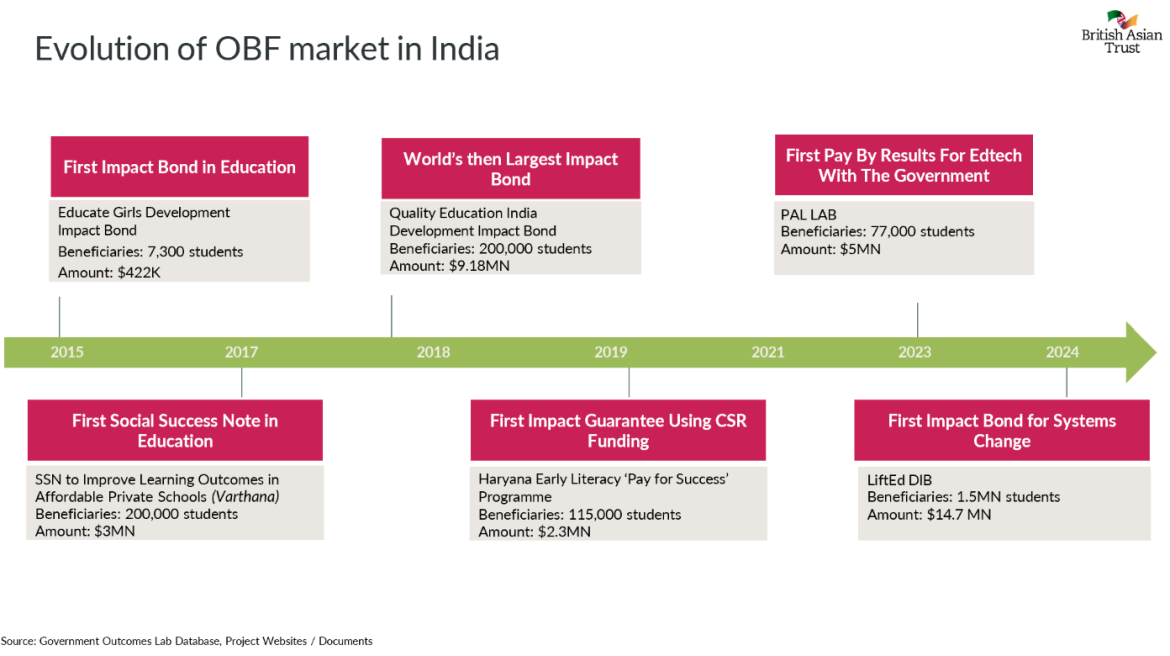
Outcomes-based financing (OBF) ties funding to independently verified, pre-defined results rather than inputs or activities. In India, this approach has gained prominence since 2015, beginning with the Educate Girls Impact Bond that served as an important proof of concept and paved the way for a range of outcomes-based financing models in education to flourish.
Diverse stakeholders engaged in this journey span philanthropic foundations, corporate social responsibility funders and government bodies, reflecting a growing ecosystem committed to outcomes-driven approaches.
Leave a comment
Your email address will not be published. All fields are required.