
School meals: Given multisectoral benefits, who should share the cost?

The benefits of school meals accrue across multiple sectors including health, social protection, agriculture and education. But how to make sure that other sectors benefitting from school meals programs invest more in them as well?

by Donald Bundy, London School of Hygiene & Tropical Medicine, and Noam Angrist, What Works Hub for Global Education
|
4 minutes read
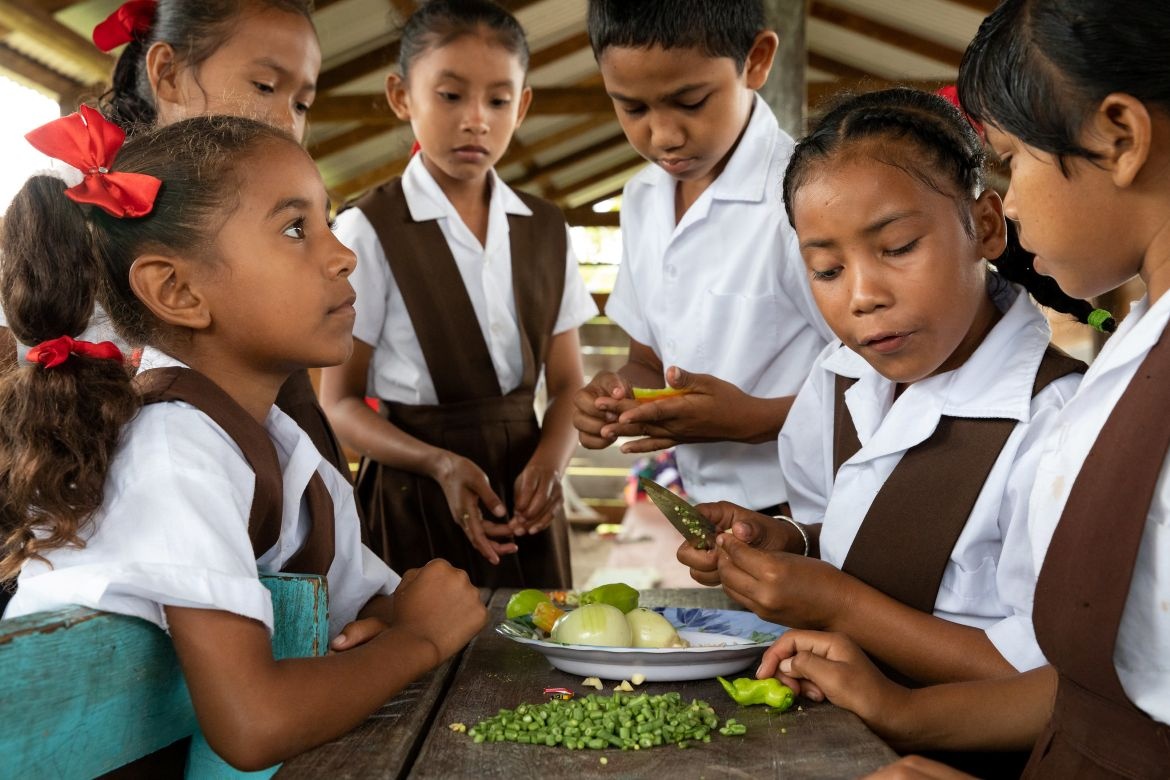
Students work together to prepare for a "bush cook" (cooking outside) as part of their national holiday celebrations in Aranaputa Primary school, Region 9, Guyana. Credit: GPE/Kelley Lynch

Students work together to prepare for a "bush cook" (cooking outside) as part of their national holiday celebrations in Aranaputa Primary school, Region 9, Guyana.

Credit: GPE/Kelley Lynch

The well-being of school children is a key determinant of their educational achievement.

Since the adoption of universal education as a United Nations sustainable development goal, the education sector has sought to strengthen education outcomes by improving traditional education inputs such as teacher training and textbooks.

It is now increasingly apparent that improving education outcomes will require a greater share of investments in the health and well-being of learners as well.

In November 2024, UNESCO celebrated the importance of learners’ well-being as a key theme at the Global Education Meeting in Fortaleza, Brazil.

This has been a long and thoughtful journey with its origins in the Education for All agenda and the launch of the FRESH (Focusing Resources on Effective School Health) Framework by UNESCO and partners at the World Education Forum in Dakar, Senegal in 2000.

Research studies increasingly show that appropriate health interventions can promote both student well-being and educational outcomes. Systematic reviews of school meals programs show their benefits to increasing education outcomes (see also Kristjansson et al., 2007).

UNESCO has led two reviews (Ready to learn and thrive and the 2025 Global Education Monitoring report on education and nutrition) that further summarize these conclusions.

For many governments, the COVID-19 pandemic further reinforced the importance of investing in learner well-being.

Well-intentioned school closures to help reduce disease transmission had the terrible collateral consequences of not only damaging education outcomes but also adversely affecting school children’s access to critical school-based support systems such as school meals.

This crisis galvanized government action worldwide to reinstate and improve support for school nutrition, including the creation of the School Meals Coalition.

With a current active membership of 109 countries, the Coalition has become one of the most successful country-driven multilateral initiatives in support of the well-being of schoolchildren.

High returns for learning

School-based health programs—such as those focused on school meals, deworming and malaria prevention—are important ways to support not only the health but also the education of children.

The education benefits achieved from health interventions when measured by global education metrics such as learning adjusted years of schooling (LAYS) suggest their impacts can also rank better than some of the most widely adopted reforms to improve learning (such as reducing the number of children in a classroom per teacher/class size):

School meals: Given multisectoral benefits, who should share the cost?

Learning-Adjusted Years of School (LAYS) gained per by intervention category


Source: Angrist et al. (2025) “How to improve education outcomes most efficiently? A review of the evidence using a unified metric.”

Many governments have embraced the benefits of school meals. The latest statistics from the World Food Programme suggest that 418 million children are fed every school day with a global budget of some US$48 billion—98% of which is funded from domestic sources.

But these are not just high-income country affairs.

The two largest school meal programs in the world are wholly self-funded by India (reaching 90 million children daily) and Brazil (reaching 40 million children daily). Nor are they temporary fixes: Finland, Japan and Sweden have each sustained and celebrated national universal school meals programs for more than 80 years.

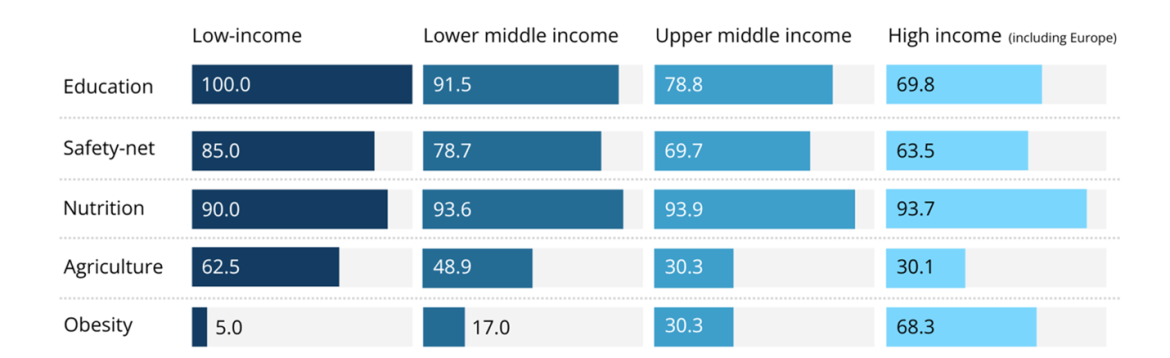
Most governments have introduced school meals to achieve multiple objectives and view the cost in terms of their returns to multiple sectors:

School meals: Given multisectoral benefits, who should share the cost?

Percentage of countries identifying the domains that school meals programs support


Source: D. A. P. Bundy et al. (2024) School Meals, Social Protection, and Human Development: Revisiting Trends, Evidence, and Practices in South Asia and Beyond.

School meals have substantial externalities in that the benefits of school meals accrue across multiple sectors including health, social protection, agriculture and education.

Recent analyses (see also the World Food Programme’s report on the state of school feeding and Verguet et al., 2020) show that if all the sectoral benefits are accumulated, then they provide high returns on investment with every $1 invested in school meals yielding an economic return of $7 to $35.

These analyses reveal the value of considering the multisectoral returns to school meals with a whole-government perspective.

What this means for the education sector

From a research perspective, we need more research into cost-effective delivery models to further address the cost concerns of school meals and we need to better quantify their returns across sectors—a critical component to make the case for investing in school meals.

From a public policy perspective, it’s clear many of the sectors that benefit directly from school meals programs are underinvesting at present.

It would be to the benefit of the education sector and schoolchildren worldwide to make sure investment in school meals across sectors is requisite with their returns.

#####

Read other blogs in this series

Related blogs