
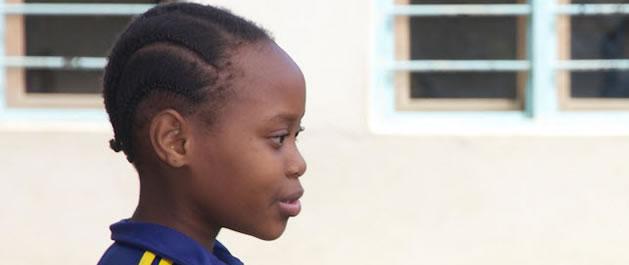
On the International Day of the African Child, Mery stands out, but her story is only the beginning
Mery knows there’s something special in her e-reader, something life-changing, even if that’s only a vaguely defined feeling.
The 11-year-old student at the Upendo School in Tanzania’s Arusha region has been whizzing through Swahili and English e-books since she got a Kindle e-reader late last year. One of her favorite books, so far, is The World Atlas. After reading it, she decided she wanted to be a pilot and travel the world she’s exploring in her mind. That’s what she told the Worldreader team who was in the area a few weeks ago.
We know Mery’s just starting to grasp the power of books and understand how she can use the knowledge they contain to create advantages for herself. What happens when she starts reading inspiring stories coming from a new generation of African writers, browses international best-sellers, peruses science and math textbooks or downloads classics that have endured for centuries?
This week as we honor the African child (June 16 marks the International Day of the African Child), we should look at Mery–and children like her–and imagine the endless possibilities before them. If we believe Mery could be a force that shapes a generation, what would the collective impact be if Mery’s ambition was replicated hundreds of thousands of times by other kids in Tanzania, one of the newest developing country partners of the Global Partnership for Education
In a place where average literacy rates hover about 73 % – far below the worldwide average of about 84 % – how could access to books and low-cost technology propel nationwide change?
Interestingly, Tanzania’s Prime Minister Mizengo Kayanza Peter Pinda is wondering the same thing.
A Prime Minister’s promise
During a Worldreader e-reader launch at two schools in the Usa River Valley in May, Prime Minister Pinda talked to our staff and school leaders, listened to children reading digital books and immediately saw the potential of a better future for his country. His observation sparked a promise to empower children and families across his country.
“The cost of an e-reader program cannot be compared to the cost of another generation of illiterate and semi-literate children,” Prime Minister Pinda said to more than 2,000 people attending the community event at the Nangana and Nambala schools. “I am going to personally oversee this program in a school I sponsor, and will ask my ministers to support this program throughout Tanzania.”
Prime Minister Pinda’s vision, we hope, resonates with other political leaders, educators and the development community around the world. It boils down to a simple message: Fighting illiteracy is critical to advancing social innovation in Africa and elsewhere.
One of the main issues many governments face, however, is finding and allocating adequate resources for the right information, communication and technology (ICT) tools. There are several cost-effective ways to address this literacy challenge:
- Digitize and make available as many African and international books as possible, and let people chose what to read;
- Bring easy-to-use technology, such as Kindle e-readers or a reading application on a feature phone, into schools, libraries and communities, even in the most rural and remote areas; and
- Expand public and private partnerships to have a bigger impact.
The social innovation crossover
As a literacy nonprofit working for social innovation in Africa, Worldreader sees how embracing the above activities have begun to transform reading in Ghana, Kenya, Malawi, Rwanda, South Africa, Uganda, Zimbabwe — and, of course, Tanzania.
This is fundamental–access to books improves lives. But, in places where printed materials are essentially nonexistent and difficult to deliver, widely-available ICT tools and better mobile technology infrastructure offer viable ways to rollout large-scale and cost-effective literacy programs. Coupled with regional and global publishing partnerships, books people can relate to–in local languages they speak–are instantly available with a touch of a button, eliminating expensive logistics costs.
Public and private partnerships, too, pave the way for broader literacy improvements. Besides closing a funding gap, they create excitement about a project, build momentum and take the cause further than one organization can achieve alone.
In fact, the e-reader program at Mery’s Upendo School is the direct result of a partnership Worldreader helped forge between the school, its primary funder AfricAid, and its sponsor Thanks Be To God Foundation. The recent launches at the Nangana and Nambala schools also stem from a partnership with the Nelson Mandela Institute. In that case, Worldreader helped the organization secure donations from two private funders to bring 300 e-readers and 36,000 e-books in Swahili and English into the classrooms. Neither launch may have happened without these strong partnerships.
Now, with Prime Minister Pinda’s support–at least in principle and hopefully soon in the form of a high-level educational commitment and financial investment to put more digital libraries into children’s hands–Tanzania could well be a place where the fight against illiteracy merges with the road to social innovation.
If that happens and the education, political and development communities worldwide champion initiatives like these, then watch out. Mery and the kids of Tanzania WILL be the force of change we think they can be.