Education is a powerful driver of inclusive growth

How useful has education been at reducing poverty and inequality? And how can education policies be designed to ensure a more inclusive growth process?

by Amory Gethin, World Bank Development Research Group
|
5 minutes read
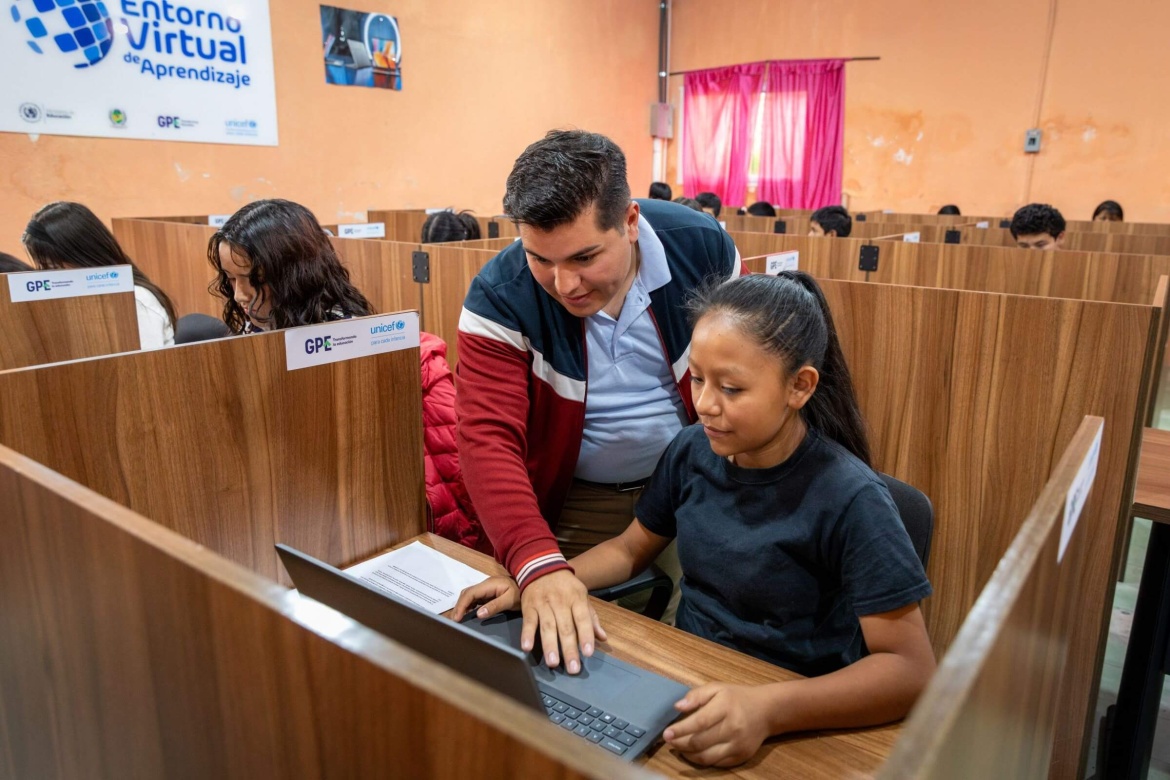
Teacher Eric Orrego helps student Meybelin Yesenia Cobox Urizar at the Virtual Learning Environment (or EVA, short for Entorno Virtual de Aprendizaje) in Huehuetenango City, Guatemala. Credit: GPE/Kelley Lynch

Teacher Eric Orrego helps student Meybelin Yesenia Cobox Urizar at the Virtual Learning Environment (or EVA, short for Entorno Virtual de Aprendizaje) in Huehuetenango City, Guatemala.

Credit: GPE/Kelley Lynch

Education is often mentioned as a key input of economic development, yet much remains to be understood when it comes to who benefits from education policy and why.

New evidence shows that in addition to explaining a substantial fraction of worldwide growth, education has played a key role in making the growth process more inclusive.

Education policies can be powerful tools for mitigating income and gender inequalities at the condition that they are sufficiently well designed to do so.

Education’s role in reducing global poverty and gender inequality

Existing studies in economics tend to focus on the effects of education on individual incomes. Evidence is much weaker when it comes to who benefits most from education policies and by how much.

In my research, I investigate how useful education has been to not only improve economic growth but to also reduce global extreme poverty and gender inequality in the past decades.

The conclusions that arise from this analysis are clear.

Under conservative assumptions, I find that:

  1. Education accounts for 50% of worldwide economic growth since 1980.
  2. Education accounts for 70% of growth among the world’s poorest 20%.
  3. Education accounts for at least 50% of reductions in gender inequality worldwide.

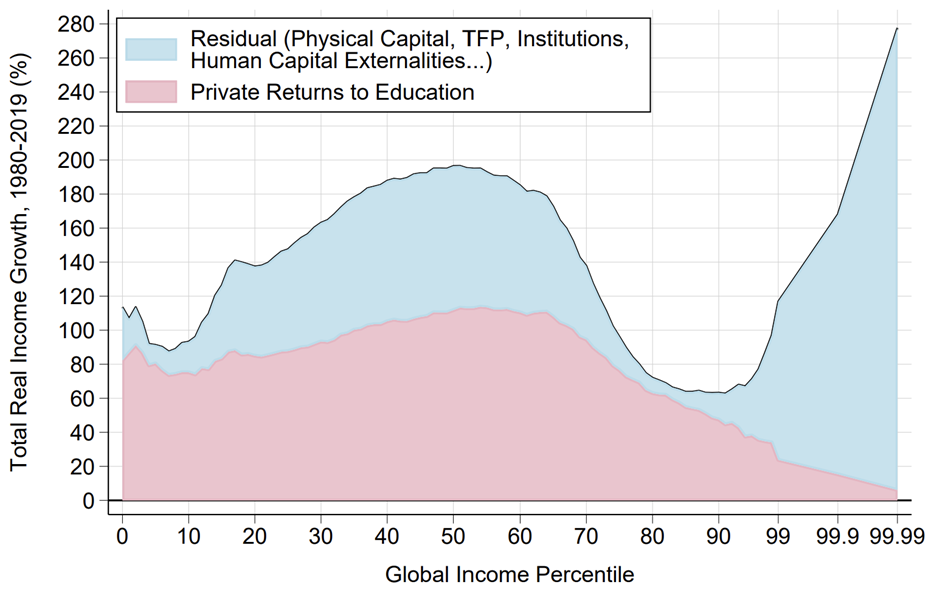
The takeaway of this analysis is best summarized below where real income growth for all individuals in the world since 1980 has been plotted, from the poorest 1% to the richest 0.01%:

Education is a powerful driver of inclusive growth

Education and the Distribution of Global Economic Growth, 1980-2019

Notes. The figure plots total real income growth by global income percentile from 1980 to 2019, decomposing it into a part that can be explained by private returns to schooling and an unexplained component. The upper shaded area represents the growth rates that would have prevailed absent any improvement in the education of the world’s working-age population since 1980. The lower shaded area represents the corresponding contribution of education to economic growth. Taking the ratio between this contribution and actual growth rates, education explains about 70% of growth for the world’s 20% poorest individuals.

This “elephant curve” of global inequality and growth highlights that growth has been highest for middle-income groups (mainly in China and India) and top-income groups (top-income earners in rich countries) of the world distribution of income.

The lower shaded area shows growth that can be explained by educational expansion, while the upper shaded area corresponds to residual growth coming from other factors (such as physical capital or technology).

Education turns out to explain a considerable fraction of growth for individuals previously living in poverty across the world. Overall, it has played a key role in mitigating the rise of global income inequalities.

3 takeaways to make education policies more inclusive

The reason why education has been so beneficial for those living at extreme poverty levels is not only that low- and middle-income countries have made progress in providing education. It’s primarily because education policy benefits low-income earners within each country.

The inclusive nature of education policy is directly visible in landmark historical policies such as Indonesia’s 1970s INPRES school construction program.

In recent research, I estimated that this policy disproportionately benefitted low-income earners who saw their income increase by 20% for every extra year of schooling enabled by the policy, compared to an income increase of just 10% for the richest individuals.

Why is it then that education can be such a powerful tool for ensuring inclusive growth?

There are 3 key aspects that should be kept in mind when designing education policy:

1. Education has general equilibrium effects

This is impacting not just individuals who receive education but whole economies.

We often think of education as improving workers’ individual incomes. Yet, expanding education also has large indirect effects on the wages of other workers: increasing the supply of skilled workers reduces their relative wage and pushes up the relative wage of workers who have not received skills training or completed formal education.

In other words, expanding education has large indirect, positive effects even on workers who have not completed education because of supply-and-demand factors.

Empirical evidence suggests that these effects are enormous, accounting for as much as 40% of the benefits documented above for individuals living in poverty.

Policy makers should be aware that improving access to education has major implications for the economy as a whole and not only for the workers directly benefitting from access to education.

2. Education interacts with technical progress

Another important result is that education policy should be tailored to technological change.

In many countries, technical progress has been skill-biased in recent decades: firms are in need of a growing share of skilled workers to continue growing. In this context, it’s not enough that education should adapt to new technologies: countries should primarily make sure to educate enough skilled workers.

This simultaneously allows countries to make the best use of new technologies and to ensure the fruits of technical change aren’t captured solely by a tiny minority of over-skilled individuals.

While basic education is important, expanding access to higher levels of education is also necessary in the presence of skill-biased technical change not only for efficiency, but also for equity.

3. Education has variable returns

This means who benefits and at which scale depends on different factors. The returns to schooling vary not only across countries, but also by education level within each country.

A general finding is that returns are convex: they tend to be much higher for tertiary/higher education than for basic education, especially in low-income countries. This tends to make education less inclusive than it could be given that access to university is concentrated among children from more privileged socioeconomic backgrounds.

There are 2 complementary solutions to make the education system more inclusive.

First, more resources should be devoted to improving the quality of basic education so as to increase its returns as it’s a persistent challenge in many low-income countries.

Second, low- and middle-income countries should also improve access to higher education so that its benefits are more broadly shared and indirectly contribute to reducing labor market inequalities through the supply-and-demand effects outlined above.

Inclusive education policy isn’t just about teaching more people. It’s about shaping fairer, stronger economies for everyone.

Investing wisely in education means investing in a future where more people can share in the opportunities that that growth creates, multiplying the possibility for every girl and boy as education systems can shape not just later opportunities and careers but entire economies.

#####

Read other blogs in this series

Related blogs

Leave a comment

Your email address will not be published. All fields are required.

The content of this field is kept private and will not be shown publicly.

Comments

  • No HTML tags allowed.
  • Lines and paragraphs break automatically.
  • Web page addresses and email addresses turn into links automatically.