GPE 2030: Transforming education systems for a changing world

GPE launches GPE 2030, the partnership’s strategic plan for the next 5 years, to respond to partner countries’ ambition to deliver a quality education for every child; and ensure that learning equips young people with the skills they need to realize their full potential and contribute meaningfully to their societies.

by Jo Bourne, GPE Secretariat
|
5 minutes read
Grade 4 students work on math problems at Escuela República de Francia in Guatemala City, Guatemala. Credit: GPE/Kelley Lynch

Grade 4 students work on math problems at Escuela República de Francia in Guatemala City, Guatemala

Credit: GPE/Kelley Lynch

The world is changing faster—and more unevenly—than at any point in recent history.

Conflict, climate shocks, demographic pressures and fiscal constraints are reshaping societies and economies while technological change is redefining the skills young people will need to thrive.

In this context, education is not a discretionary social cost. It is an essential investment in stability, prosperity and peace—and one the world cannot afford to delay.

Yet the global education crisis remains profound. Too many children are still excluded from school and too many who are enrolled are not learning.

Patterns of exclusion continue to fall disproportionately on girls, children with disabilities, refugees and other marginalized learners, often compounded by poverty, conflict, school-related gender-based violence and climate-related shocks.

Without urgent and sustained action, these inequalities risk deepening, undermining social cohesion and economic growth for generations to come.
It is against this backdrop that GPE launches GPE 2030—the partnership’s strategic plan for the next 5 years.

The strategy responds directly to partner country ambition to deliver a quality education for every child and to ensure that learning equips young people with the skills they need to realize their full potential and contribute meaningfully to their societies.

GPE 2030: Transforming education systems for a changing world

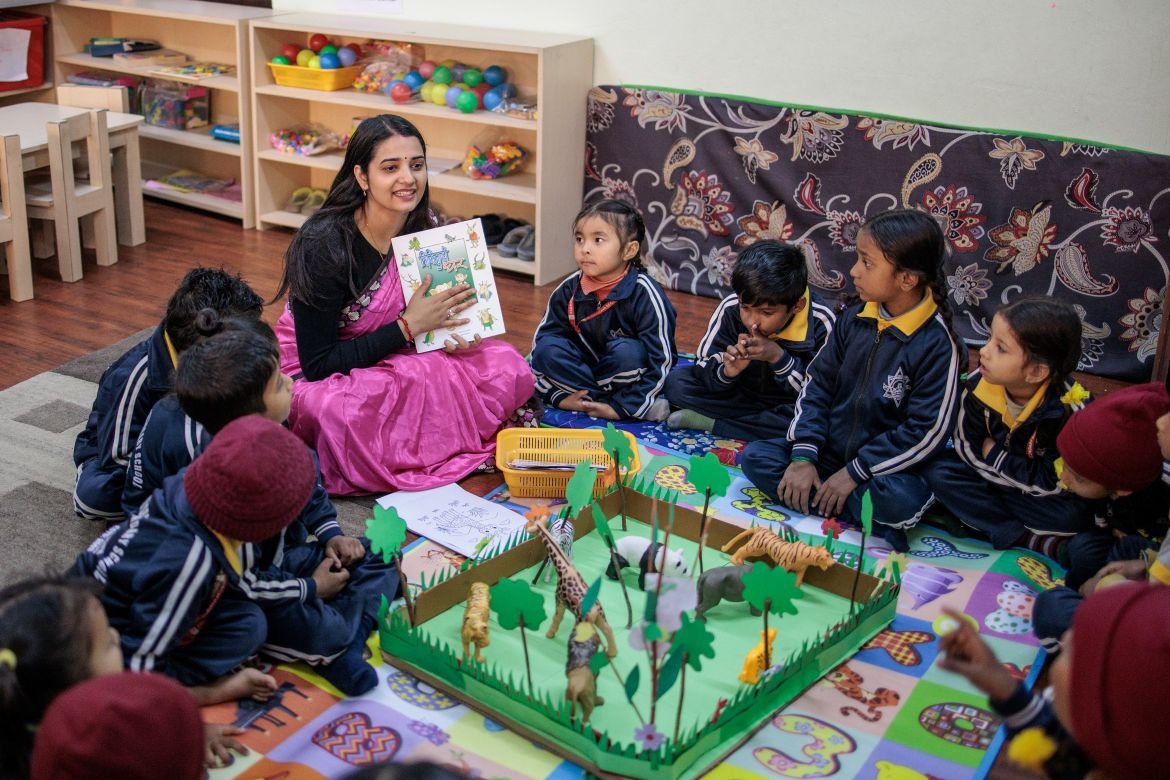
Pre-primary teacher Dhan Kumari Dhakal and her students play and learn about animals. Padmodaya Secondary School, Kathmandu, Nepal.

Credit:
GPE/Federico Scoppa

Building on what works: Lessons from GPE 2025

GPE 2030 builds squarely on the lessons learned during the implementation of GPE 2025.

Over the past 5 years, partner countries and their education communities demonstrated that progress accelerates when reforms are: country led, clearly prioritized and supported by aligned partnerships and financing.

Under GPE 2025, countries made important gains in advancing gender equality and inclusion—strengthening girls’ education, addressing school-related gender-based violence and expanding attention to learners previously left behind, including children with disabilities and refugees.

These efforts reinforced the importance of tackling multiple and intersecting barriers to education through systemwide approaches rather than isolated interventions.

Experience also showed that education systems must be resilient to shocks. Climate change, conflict and public health emergencies repeatedly disrupt learning, underscoring the need for stronger infrastructure, preparedness and financing that can sustain education delivery in times of crisis.

GPE 2030: Transforming education systems for a changing world

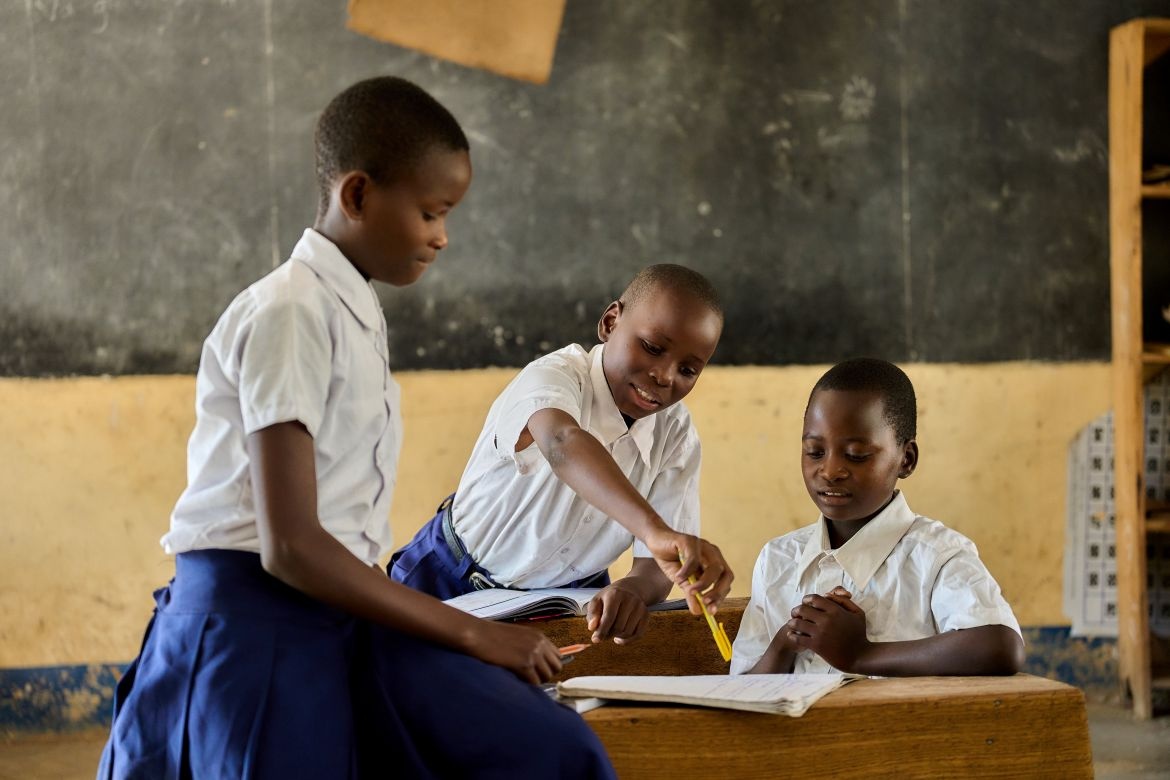
Class 7 students during a class. Tanzania.

Credit:
GPE/Mrutu (Trans.Lieu)

A continued ambition: System transformation at the center

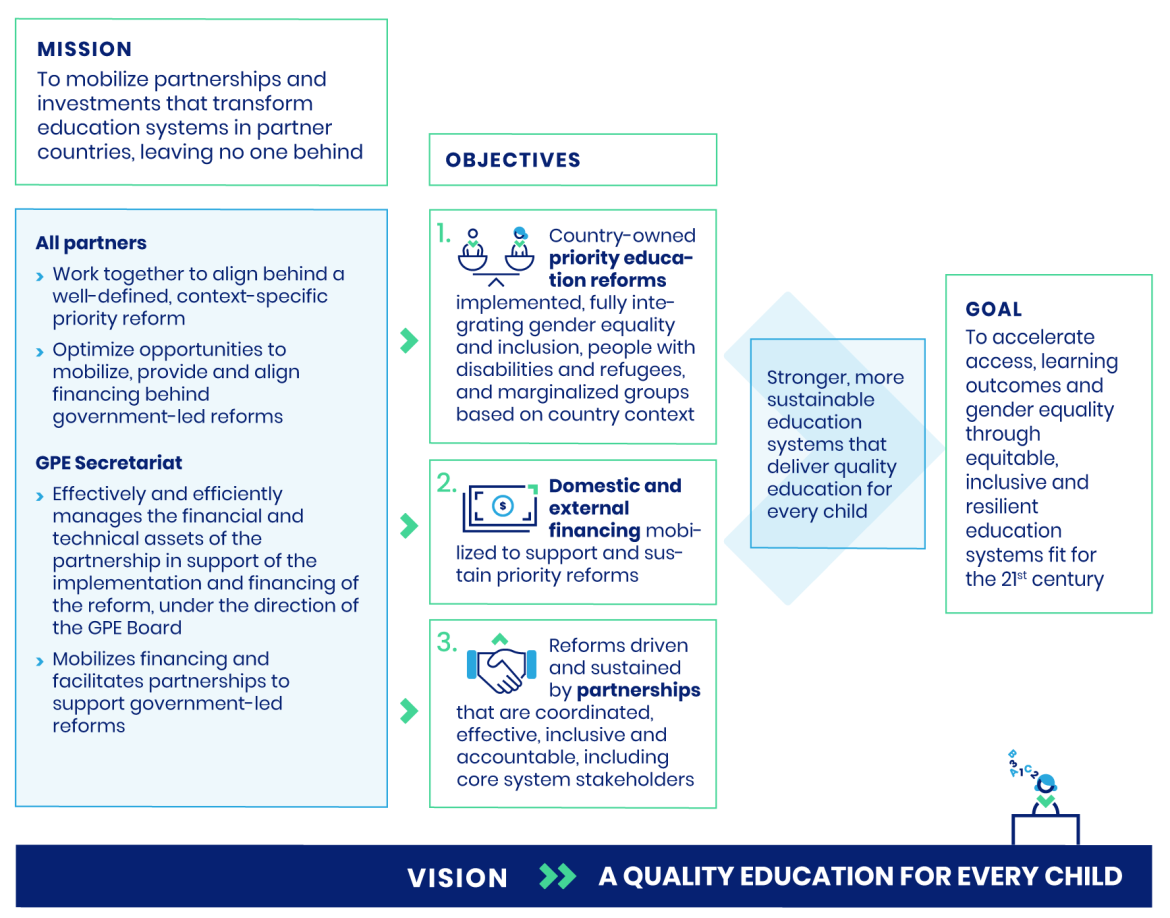
GPE 2030 is grounded in a simple but powerful idea: when countries lead clearly defined, inclusive priority reforms—supported by adequate and well-spent domestic and external financing as well as sustained by coordinated and effective partnerships—education systems become stronger and are better able to deliver quality education for every child.

GPE’s vision remains a quality education for every child. Its mission is to mobilize partnerships and investments that transform education systems in GPE partner countries, leaving no one behind. And its goal is clear: to accelerate access, learning outcomes and gender equality through equitable, inclusive and resilient education systems fit for the 21st century.

GPE 2030 is organized around 3 mutually reinforcing objectives:

  • Country-owned priority education reforms are implemented, fully integrating gender equality and inclusion, including children with disabilities, refugees and other marginalized groups based on country context.
  • Domestic and external financing is mobilized to support and sustain those priority reforms.
  • Reforms are driven and sustained by coordinated and effective partnerships that engage all core education system stakeholders.

What’s changing in GPE 2030—and why it matters

While the ambition to transform education systems remains unchanged, GPE 2030 deepens and sharpens how the partnership works to deliver results at scale.

First, the strategy makes the link between education system transformation and sustainable financing more explicit than ever before. Strong systems require predictable, well-deployed resources. And that starts with domestic public finance. GPE 2030 reinforces education as an investment in human capital, supporting countries to embed education at the center of national development and fiscal policy, and to improve the volume, equity and efficiency of education budgets.

Second, GPE 2030 places a stronger emphasis on results and learning outcomes, supported by improved data, monitoring and adaptive delivery. Priority reforms are expected to integrate gender equality, address school-related gender-based violence and respond to the needs of children with disabilities and refugees while strengthening system capacity to deliver education at scale.

Third, the strategy expands GPE’s role in leveraging innovative and catalytic financing, including through instruments that unlock additional public and private resources as well as partnerships with development banks, philanthropy and the private sector—helping countries sustain reforms over time.

Finally, GPE 2030 reinforces the central role of partnership. Transforming systems is not the work of ministries alone. It depends on teachers who are supported and valued, communities and civil society that champion reform and accountability, and young people whose voices help shape the policies that affect their futures.

GPE 2030: Transforming education systems for a changing world

GPE 20230's theory of change

A shared responsibility and a call to action

History has shown that lasting progress in education is achieved through long-term national leadership, sound investment and strong partnerships, not short-term or fragmented efforts.

At a moment of global uncertainty, the case for education has never been clearer or more urgent.

GPE 2030 is both a strategy and a call to collective action.

It invites governments, donors, civil society, teachers, youth, philanthropy and the private sector to align behind country-led reforms and sustainable, climate-resilient financing pathways that can deliver results at scale.

Together, we can ensure that education becomes a powerful engine of opportunity rather than inequality—and that every child, everywhere, can learn, thrive and contribute to a more stable and prosperous world.

GPE stands ready—better equipped than ever—to work with partners to transform education systems and multiply possibility for all learners.


Multiply possibility: GPE Case for Investment 2026-2030

Education unlocks infinite possibilities, transforming lives, communities and the world.

Discover the Case for Investment

Related blogs

Comments

good work

More appropriations to your change you are bringing in our community

Leave a comment

Your email address will not be published. All fields are required.

The content of this field is kept private and will not be shown publicly.

Comments

  • No HTML tags allowed.
  • Lines and paragraphs break automatically.
  • Web page addresses and email addresses turn into links automatically.