On June 16, 1976 around 200 children were shot and killed in the streets of Soweto because they dared to suggest they had the right to an education.
On June 16, 2014 the fate of 276 girls, who dared to try and go to school in Nigeria, still lies in the hand of their abductors.
It has been 38 years since the tragedy of that day in June 1976, which led to the African Union creating an annual Day of the African Child. Thirty eight years and yet it seems so little has changed. Poverty, violence and discrimination against children across the continent, and around the world, are still preventing millions of girls, and boys, from accessing their right to an education.
Girls continue to be the most affected, with 65 million adolescent girls out of school around the world, and as many as four out of five girls not even completing primary school in some Sub-Saharan African countries. Why? Because governments are still not investing enough money in education and when they are, they are not investing well enough.
More funding needed for basic education
The education community has set an international benchmark for all governments to spend a total of 20% of their national budget on education, with at least half of that to be spent on basic education. Despite increases, such as an average rise of 6% annually since 2000 in Sub-Saharan Africa, investment is far from keeping up with the demand for public education.
Official Development Assistance (ODA) allocated to education has fallen 10% between 2010 and 2012.
We are facing an education financing crisis, with some estimates putting the financing gap at some $26 billion each year.
The money that is available needs to be spent in a way that provides sustainable, quality education for all children, including the most marginalized and hard to reach. This is why we are calling on all governments to undertake a gender review of their Education Sector Plans and fund the results, to ensure measures are taken to specifically target girls. At present rates, poor rural girls in Sub-Saharan Africa will not all have access to primary education until 2086!
Governments must also listen to the people who know the most about their education experience, children and young people themselves. They must be part of the solution.
Let’s stand up for the children of Africa!
This year’s Day of the African Child theme is Quality Education for All Children. The day provides us with an opportunity to stand up and say this is not acceptable, to say it is time for governments to show they care about the education of their children; the future of their countries.
This is why at Plan International we have organized a children’s takeover of the African Union on June 16. We are supporting children from across the continent to call on their leaders to step up and invest more in education. We are working on the day with our partners at A World At School, UNICEF, Women Thrive International and many more to support children and young people to run events in over 70 countries around the world to make the same call. This includes calling on donor governments to increase their support for global education. And we are calling on them to act now and to show their investments when they have the opportunity in ten days’ time.
On June 26, the Global Partnership for Education hosts its replenishment conference for 2015-2018. There has never been a more urgent need for action.
10 days of action – join us now!
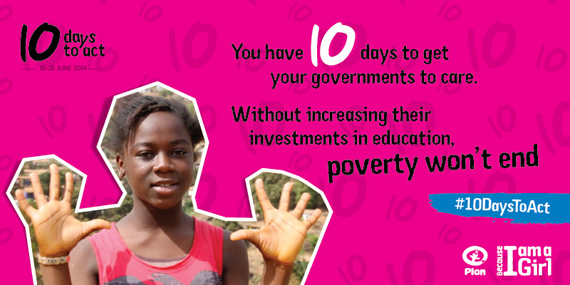
This is why we are starting our 10 Days to Act campaign on June 16. If you join us we can make sure governments are increasing their investment in education and providing all children with the safe, quality education they deserve. Here are 10 simple ways how you can show your support over the next 10 days. We must make sure that in another 40 years there is are no further tragedies occurring simply because children dared to go to school.
1. Sign the petition
If you haven't done so already, please sign the global petition for education before 26 June. It calls for an extra $4 billion to be pledged by governments to support the global education emergency. Don’t forget to share it on social media!
2. Promote the 10 Days To Act video
Tweet this message to promote our 10 Days To Act video and create a buzz for the 10-day period.
3. Share our teaser video
Share a short teaser of the 10 Days To Act video.
4. Write to your government
Please write to your government’s Minister for Education before 20 June asking them to increase their global education investment. You can use this letter template to prepare your message. Please also include a copy of the Global Campaign for Education's replenishment letter with your letter - download it in: English | French | Portuguese | Spanish | Arabic
5. Post a selfie
Tweet a #10DaysToAct selfie from 16 June - urging your government to invest.
6. Follow Plan on social media
Join us and take part in all the 10 Days To Act events by following Plan on Twitter and Facebook.
7. Spread the word
Use every way you can think of to tell your colleagues, friends and family about this list and what they can do to support the 10 days.
8. Promote our new documentary
Watch out for the 16 June launch of our documentary featuring a girl from Sierra Leone – and share it on social media.
9. Get our youth advocacy toolkit
Check out our youth advocacy toolkit and see how you and your friends can take action for education.
10. Check out our infographics
Right click on our infographic below and save it to your device - then share far and wide on social media from 16 June. Check back - we'll be posting a new infographic here every day in the 10 Days to Act countdown.