
At the start of 2026, Zimbabwe’s Ministry of Primary and Secondary Education took a significant step toward improving access to quality education for all children.
Zimbabwe : Strengthening digital learning in underserved schools
3 minutes read
With support from GPE and UNICEF, Zimbabwe is equipping disadvantaged schools with ICT devices to unlock the full potential of digital learning.
With support from GPE and UNICEF, the ministry acquired 815 laptops, 708 projectors and 2,112 tablets, which will be distributed to 113 schools across seven districts in the provinces of Manicaland and Matabeleland South.
The program targets schools in rural and hard-to-reach areas, where access to digital resources has been limited, helping ensure that learners in underserved communities are not left behind.
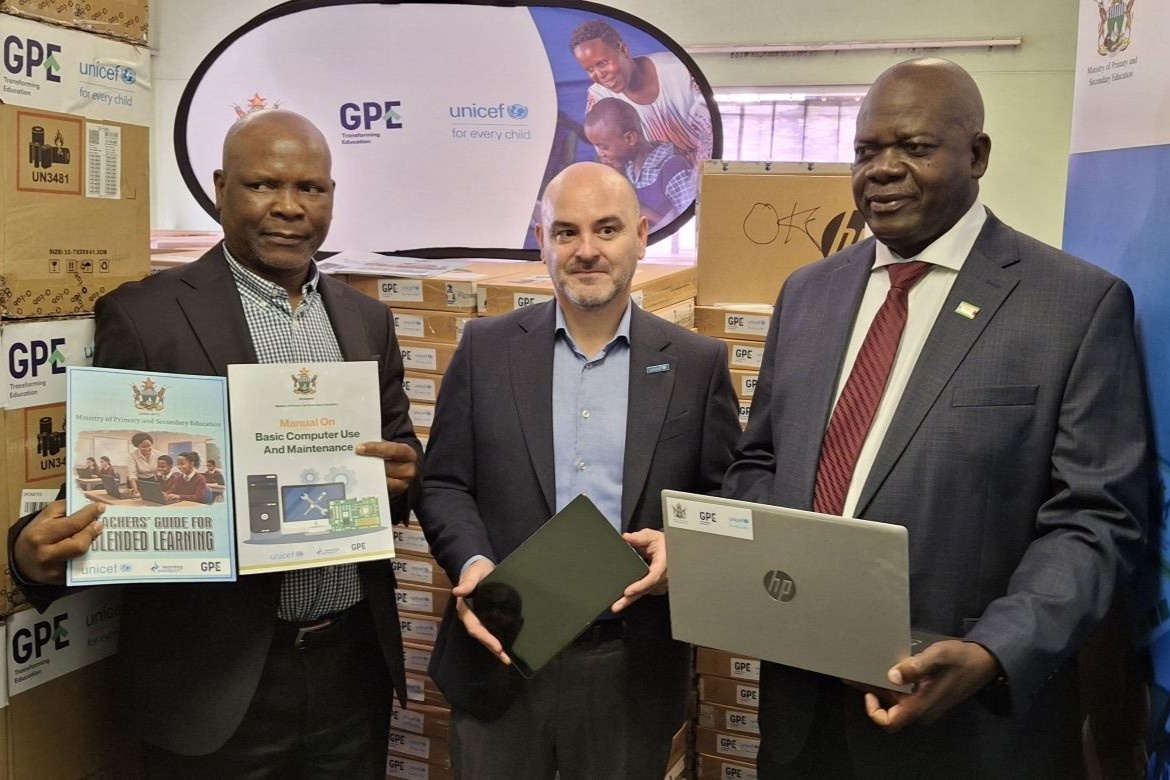
Hon. Prof. Torerayi Moyo, Zimbabwe’s Minister of Education; Fiachra McAsey, Acting UNICEF Representative; and Moses Mhike, Permanent Secretary at the Ministry of Primary and Secondary Education, at the handover of digital learning devices in Harare on January 5, 2026.
Credit:
UNICEF Zimbabwe/2026/Tapuwa Mutseyekwa
Equipping schools for digital learning
The selected schools have already benefited from a solar panel installation program funded by the UK’s Foreign, Commonwealth and Development Office (FCDO), as well as the installation of offline servers hosting Zimbabwe’s Learning Passport, a free digital learning platform. These investments ensure a reliable power supply and access to quality digital content, even in low- or no-connectivity environments.
The newly provided ICT devices complete the infrastructure required to effectively implement digital learning and maximize the use of the Learning Passport at schools.
By building on prior investments at target schools, the program takes a strategic, systems-based approach to digital education, ensuring that learners in disadvantaged communities are not left behind in Zimbabwe’s digital transformation.

“This initiative marks an important milestone in our collective effort to ensure that every child, regardless of where they live, has access to quality digital learning. By complementing earlier investments in solar power and offline digital platforms with ICT devices, we are enabling schools to move from access to effective use of technology in the classroom. This is about building resilient, inclusive and future-ready education systems that leave no learner behind.”
Ensuring effective use of digital learning devices
To support sustainability and effective classroom use, teachers are receiving structured training focused on the pedagogical integration of digital tools.
Two user manuals have been developed: one to guide device management, instructional use and basic maintenance, and another to empower teachers in applying a blended learning approach.
Taungana Ndoro, Director of Communications and Advocacy at the Ministry of Primary and Secondary Education welcomed the initiative: “This strategic contribution from UNICEF and GPE directly advances our national vision for a modern, inclusive and equitable education system. This is not merely an allocation of devices, but a pivotal investment in empowering learners and educators in underserved communities.”
He added that the delivery of the devices represents a critical phase in the government’s deliberate efforts to bridge the digital divide between urban and rural children and ensure that children in every province are equipped with the skills and resources to thrive in the 21st century. “We are committed to the sustainable and effective integration of this technology into our curriculum, building on the foundation of solar power and digital platforms to foster a generation of future-ready Zimbabweans.”
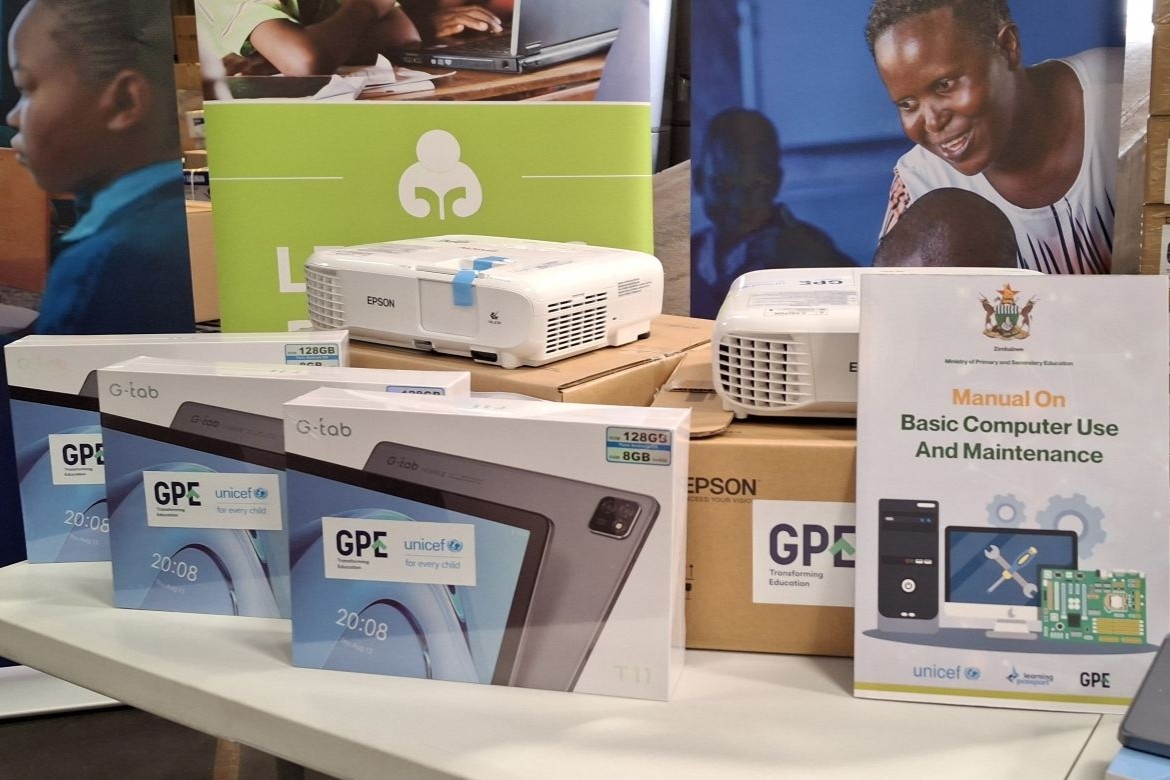
A GPE-funded package of laptops, projectors, tablets and user manuals distributed to 113 schools in underserved and hard-to-reach communities, helping bridge the digital divide between urban and rural areas.
Credit:
UNICEF Zimbabwe/2026/Tapuwa Mutseyekwa

“Access to quality digital education is a critical part of equipping learners with future-ready skills. This initiative reflects GPE’s dedication to building resilient and inclusive education systems that prepare all learners for the future."
From access to meaningful learning
The digital learning activities are funded in part by GPE–including a US$19.8 million system transformation grant and a $8.66 million Multiplier grant–with implementation support from UNICEF for the period 2023-2026.
With the full digital learning package now in place—power, content, devices and trained teachers—classrooms can move beyond basic access.
Teachers can project interactive lessons, learners can practice at their own pace using tablets, and schools can continue teaching even when connectivity is limited.
These government-led efforts, with support from partners like GPE and UNICEF, are strengthening learning continuity in Zimbabwe’s most underserved communities.
Leave a comment
Your email address will not be published. All fields are required.