

LiftEd was launched in 2024 with the aim of improving foundational learning and the ambition of reaching approximately 6.5 million children in India by 2028.
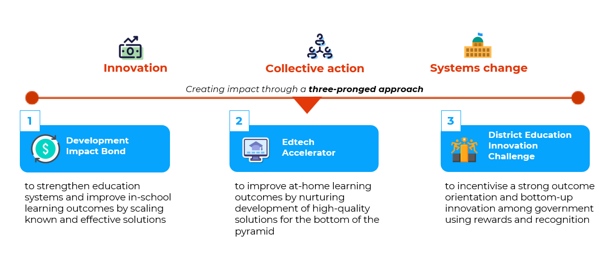
Using outcomes-based partnerships as a backbone, LiftEd is based on 3 guiding principles of innovation, collective action and systems change.
With $20 million in funding, LiftEd involves a coalition of over 26 partners and operates through 3 complementary instruments:
- The development impact bond (DIB) that supports partners who are training key government staff (e.g. block education officers, heads of school, mentors), building their capacity to improve foundational learning for children in public schools across grades 1-3, driving impact at scale through a systems-strengthening approach.
- The EdTech Accelerator that supported partners to develop high-quality, contextually relevant education technology (EdTech) products for children ages 4 to 10 from low-income communities, reaching children at home and unlocking the power of technology.
- The District Education Innovation Challenge (DEIC) that fosters an outcomes-focused orientation within government and aims to improve foundational learning and numeracy outcomes by incentivizing system actors through a 'rewards and recognition' approach to adopt innovative practices.
Together, these instruments provide a 360-degree approach to improving foundational learning and numeracy.
While the LiftEd development impact bond and District Innovation Education Challenge take a systems-level approach to strengthening what happens within the public education system and schools, the EdTech Accelerator complements this by extending learning into the home.
All 3 LiftEd initiatives use outcomes-based partnerships:
- Under the Development Impact Bond, an impact investor provides upfront funding to implementing organisations to deliver interventions. The investor is then repaid with a moderate financial return by philanthropic outcome funders based solely on the implementing organisations’ achievement of pre-agreed, independently verified outcomes.
- The EdTech Accelerator ran for 2 years, providing grants to EdTech organizations to develop products for remote learning for children from low-income communities. Year 2 scale-up grants were linked to partners’ performance against goals set in year 1.
- The District Education Innovation Challenge, funded jointly by the government and philanthropy, uses non-financial rewards and recognition to incentivize districts to adopt innovative foundational learning and numeracy practices and to improve learning outcomes, with districts ranked based on their foundational learning and numeracy performance.
Leave a comment
Your email address will not be published. All fields are required.