Nigeria: Ensuring children affected by conflict get an education
by UNICEF Nigeria, and GPE Secretariat
|
4 minutes read

Support from GPE and UNICEF in North-east Nigeria is expanding access to education, improving learning quality and strengthening education system resilience.

Ibrahim Abubakar, 12-year-old student, accelerated basic education program, Borno State, Nigeria

“I would love to become a medical doctor. I want to help people and save lives.”

Ibrahim Abubakar
12-year-old student, accelerated basic education program, Borno State, Nigeria

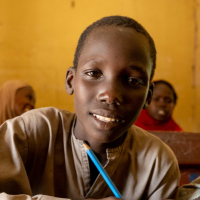
Ibrahim Abubakar lost both of his parents as an infant. Now 12, he lives with his grandmother and older sister at a camp for displaced persons in Bama, Borno State, a community affected by the protracted conflict in North-east Nigeria.

Attacks by armed groups remain a daily threat in Bama, with risks including abduction. But Ibrahim holds on to big ambitions and finds a sense of stability and hope in going to school.

He enrolled himself in an accelerated basic education program at the learning center in his camp. Supported by GPE and UNICEF, the program is facilitated by trained volunteers and helps out-of-school children develop reading and math skills.

Alongside his studies, Ibrahim works to support his family. “I farm and weave caps for sale in the mornings,” he says. “I give the money to my grandmother for food. I also attend Tsangaya [religious school] every morning.”

At his afternoon catch-up classes, Ibrahim has made friends, and they are eager to learn.

“My best friend is Muhammed and we both love the English literacy classes. I am learning two- and three-letter words, and my teacher says I am improving. I would be very happy to complete my education and speak English fluently,” he says. His mother tongue is Hausa, and students learn in both Hausa and English.

The 9-month accelerated program supports children affected by conflict to catch up on foundational learning and transition into formal schooling, putting them on a pathway toward completing secondary education.

Nigeria: Ensuring children affected by conflict get an education

Ibrahim arrives at the learning center in the displaced persons camp where he lives, building the literacy and numeracy skills he needs to transition into formal schooling.

Credit:
UNICEF/2025/Folashade Adebayo

Ensuring education access for children affected by conflict

Ibrahim’s story reflects a wider education crisis in North-east Nigeria. According to the 2025 Joint Education Needs Assessment conducted by the Education in Emergencies Working Group for the region, an estimated 2 million children are out of school.

Civil armed conflict has impacted North-east Nigeria since 2009. States in the region, primarily Borno, Adamawa and Yobe, have experienced attacks by non-state armed groups and intercommunal clashes, severely disrupting the delivery of basic social services, including education.

The government of Nigeria has prioritized inclusive, quality and crisis-responsive learning and skills development in the region. With US$5 million in GPE funding for 2024–2025, and implementation support from UNICEF, over 190,000 children affected by conflict now have improved access to education across the three states.

Results at a glance

  • 190,750 children at schools and non-formal education centers received teaching and learning materials
  • 94,400 children improved their reading and math skills
  • 19,600 children benefitted from life skills and social-emotional learning
  • 1,360 teachers were supported and equipped with psychosocial support skills, enhancing their own wellbeing and that of learners
  • 970 teachers strengthened their foundational literacy and numeracy skills, supporting quality teaching and learning
  • 2,200 school- and community-based management committee members were trained and sensitized on promoting violence-free schools.
Nigeria: Ensuring children affected by conflict get an education

With the support of GPE and UNICEF, children affected by conflict who were out of school are accessing education through catch-up classes at learning centers in North-east Nigeria.

Credit:
UNICEF/2025/Folashade Adebayo

Improving children’s reading and math skills

In addition to equipping children with foundational skills through non-formal education centers, GPE funding has helped scale up the Teaching at the Right Level (TaRL) approach across 280 formal schools in North-east Nigeria.

TaRL, which had already proven successful in over 380 schools during the 2021-2022 academic year, focuses on foundational literacy and numeracy skills.

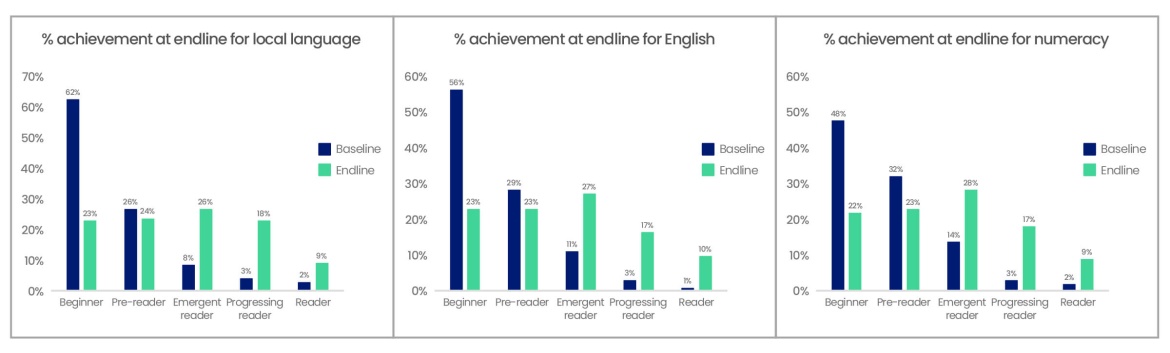
Students are assessed in reading and math and grouped according to 1 of 5 learning levels, allowing teachers to tailor instruction to each child’s learning needs. Teachers receive targeted training to plan lessons and activities that respond to these levels.

An assessment of the TaRL intervention during the 2024-2025 academic year shows encouraging progress, with most students in the 280 target schools advancing to higher learning levels by the end of the school year.

Nigeria: Ensuring children affected by conflict get an education

TaRL learning results

Together, these efforts build on the success of a previous GPE grant of $20 million (2020-2023) and have helped expand access to education, improve learning quality, and strengthen education system resilience in North-east Nigeria.

This targeted support contributes to the federal government’s systemwide goals to reduce the number of out-of-school children, improve teaching and learning especially at the foundational level, and strengthen basic education delivery – so that more children have the chance to catch up, learn and thrive.

Related blogs

Leave a comment

Your email address will not be published. All fields are required.

The content of this field is kept private and will not be shown publicly.

Comments

  • No HTML tags allowed.
  • Lines and paragraphs break automatically.
  • Web page addresses and email addresses turn into links automatically.