
Why we still need a Girls’ Education Accelerator

The Girls’ Education Accelerator provides crucial, targeted funding to strengthen reforms that help girls facing the greatest barriers to schooling. As GPE’s dedicated window for girls’ education, it reinforces broader gender inclusive efforts and supports those in the most challenging contexts to access and benefit from learning.

by GPE Secretariat
|
7 minutes read
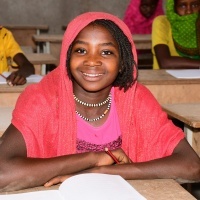
Student Naomi Bakeré at the Boyali 2 school, in the village of Boyali, Central African Republic. Credit: GPE/Eduardo Soteras/AP

Student Naomi Bakeré at the Boyali 2 school, in the village of Boyali, Central African Republic.

Credit: GPE/Eduardo Soteras/AP
Sereti Matipei

"It is important for a girl to get an education. Some people create limits for girls and say, ‘There's no need for girls to go to school or to learn’ because they think girls will just get married. They forget that girls can be educated and can become important people in society."

Sereti Matipei
Grade 8 student, Marble Quarry Primary School, Kenya

It costs countries $15 to $30 trillion in lost productivity and lifetime earnings when girls are not in school and learning.

Investing in girls who are of school age also has some of the highest returns for future gender equality in the economy and society, and can therefore generate large dividends for prosperity, climate resilience, public health and lasting peace and stability.

But today, 133 million girls remain out of school across the world due to multiple hurdles to getting an education such as bias, harmful social norms, poverty and violence.

The Girls’ Education Accelerator was set up specifically to change that.

As GPE’s only targeted financing window to improve education for girls in countries where they lag the furthest behind due to fragility, conflict or entrenched, harmful norms, the Accelerator provides additional funding to deepen and strengthen system‑level reform.

Reinforcing the existing focus on gender and inclusion across all GPE grants to get every girl and boy in school and learning, the Accelerator adds financing for targeted support for girls who face the most barriers in accessing education in the most challenging contexts.

The Accelerator also shows the value of combining private sector investment with GPE and public funding, maximizing the impact of private and philanthropic investments as GPE matches all investments from businesses and private foundations dollar for dollar.

From 2021 to 2025, GPE has raised $225 million for 3.6 million girls across 15 partner countries, including $179.5 million ($19.75 million from GPE Match) from sovereign donors Belgium, Denmark, Germany and Ireland as well as foundations including Dubai Cares, Harry Hole Foundation, LEGO Foundation and Open Society Foundations.


Why we still need a Girls’ Education Accelerator

Students in a drawing class at Centro Escolar Olof Palme, El Salvador.

Credit:
GPE

Financing that goes further than standalone programs

The Accelerator goes much further than a standalone girls’ education program. Working in alignment with other GPE grants, it boosts investments in the policies, strategies and programs that address the unique challenges most marginalized girls face.

The independent rapid review on GPE’s approach to gender equality under GPE 2025 found that the Girls’ Education Accelerator incentivized countries to set ambitious goals for girls’ education, especially those who are the most marginalized.

The following 15 partner countries have already accessed Accelerator funding for their support to girls’ education:

Benin El Salvador Niger
Central African Republic Eritrea Sao Tome and Principe
Chad Ethiopia Somalia
Democratic Republic of Congo Guinea South Sudan
Cote d’Ivoire Mozambique Zimbabwe
Rekia, 10-year-old student, Asheti Nomadic School, Eritrea

“I’m very happy to finally be learning. I know I’m young, but if given the chance, I’d like to take up teaching or nursing as a career to help my community."

Rekia
10-year-old student, Asheti Nomadic School, Eritrea
Hanan, 16-year-old student, Somalia

“Clean water, functional toilets and proper handwashing facilities have eliminated the physical and emotional discomfort girls previously endured. This has empowered us to focus on our studies and actively participate in classroom activities.”

Hanan
16-year-old student, Somalia

Multiplying possibility for every girl
through the Accelerator

  • Chad is embedding the recruitment and retention of female teachers into the country’s education sector planning and implementation. With $80.52 million from a system transformation grant and $25 million from the Girls’ Education Accelerator, the Programme de Refondation de l’Ecole Tchadienne (PRET, Chadian School Reform Project) fosters gender equality, girls’ education and inclusion through a multisectoral approach including community awareness campaigns, a school referral system for gender-based violence, improved school infrastructures and sanitation facilities, and increased numbers of trained, female teachers as well as women in education leadership positions.
  • In El Salvador, a $10 million Multiplier grant combined with $5 million from GPE’s Girls’ Education Accelerator is boosting efforts to close the gender gap in education across the country by creating gender-sensitive learning materials in collaboration with local authors and publishers as well as learning assessments that do not reinforce stereotypes about girls’ abilities. By mid-2025, 11,500 families had received children's literature books and supporting materials for parents and caregivers to engage in shared reading with their children in ways that foster early literacy and socioemotional skills, promote girls' empowerment at home and changes in parenting practices, transform gender norms and prevent gender-based violence. Over 50,000 more families will be reached by the end of 2026.
  • In Ethiopia, Accelerator funds have been used to create safer and more inclusive learning environments through supporting gender‑responsive pedagogy as well as strengthening prevention and response to school-related gender-based violence. Through the Girls’ Education Accelerator, 12,863 education personnel (8,574 women) have been trained on school-related gender-based violence prevention and response alongside training for 187 officials and advocates as well as 245 gender club coordinators and education leaders. These efforts complement initiatives financed by a GPE system transformation grant including leadership training for female teachers in rural schools to strengthen pedagogical and management capacity.
  • In Somalia, Accelerator funds have been used to invest in safer schools, robust child protection systems and gender-responsive teacher training have driven measurable progress, with primary enrollment rates for girls rising from 28% to 31% since 2024. In addition, gender focal points in the used the Accelerator to fund a learning exchange visit to Rwanda. Rwanda’s ministry of education shared on their experience of adopting a systems approach to achieving gender equality in education, targeting girls facing poverty, early marriage and barriers to learning tied to disability through inclusive teaching practices, community-based initiatives and school programs to improve access, school retention and learning outcomes (read more).
  • In Zimbabwe, Accelerator funds are advancing national education priorities to encourage girls to stay in school, support returning to the classroom for those who dropped out and provide safe learning environments by reinforcing collaboration between committees at district and school levels as well as with guidance and counselling teachers. A $12.4-million grant managed by the Campaign for Female Education (CAMFED) is supporting 8,300 girls in 35 districts to complete 12 years of education. It also includes access to financial support for school fees, supplies and uniforms as well as mentoring on post-school opportunities. Almost all girls supported by Accelerator funding (95%) have completed grade 10 and progressed to the next grade. Through grant support, 850 girls and young women who had dropped out of school because of early marriage and pregnancy have been able to resume their education. The peer mentorship program has reached 5,641 girls who recently completed secondary school, connecting them with young women trained to share skills to support girls in continuing further education, seeking employment or becoming entrepreneurs.

Investing in girls is investing in stronger, inclusive economies

For girls, each additional year of schooling reduces the likelihood of child marriage and increases their lifetime earnings, unlocking generational gains and expanding women’s participation in the workforce. This fuels stronger, more inclusive economies.

As part of its 5th financing campaign, GPE is seeking to raise an additional $200 million to fund the Girls’ Education Accelerator and provide quality education to 3.2 million more girls facing some of the most daunting barriers to education. Philanthropic partners like the Jannik Sinner Foundation have already pledged funding to meet this goal.

The case to invest in girls’ education is clear. With increased, targeted financing for girls’ education like the Accelerator—particularly for countries where thousands of girls are still locked out of education opportunities due to harmful social norms and poverty—achieving education for all and where it’s needed the most can become a reality.

Multiply possibility: GPE Case for Investment 2026-2030

Education unlocks infinite possibilities, transforming lives, communities and the world.

Discover the Case for Investment

#####

Read other blogs in this series

Related blogs

Leave a comment

Your email address will not be published. All fields are required.

The content of this field is kept private and will not be shown publicly.

Comments

  • No HTML tags allowed.
  • Lines and paragraphs break automatically.
  • Web page addresses and email addresses turn into links automatically.