
Why we must embrace ‘acting ahead’ in education

Concrete approaches that governments, practitioners, donors and other stakeholders in the education sector can take to protect education investments and make sure access to education is not disrupted for millions of students when crises hit.

by Petra Heusser, Geneva Global Hub for Education in Emergencies
|
4 minutes read
A student standing in a flooded classroom in Bolivia. Credit: UNICEF/UNI28313/Abramson

A student standing in a flooded classroom in Bolivia.

Credit: UNICEF/UNI28313/Abramson

For children and youth living through crisis situations, accessing quality education is a daily struggle.

On the one hand, humanitarian needs have never been higher: 234 million crisis-affected children need educational support, 85 million of whom are out of school.

At the same time, unprecedented funding cuts are forcing local and international aid actors to drastically scale back, redesign programs or even close.

No wonder that so many of us are looking for new and impactful ways to keep providing schooling in emergencies.

On June 12th, the members of the Geneva Global Hub for Education in Emergencies laid out a way forward in our new report: Acting Ahead to Protect Education Investments. It stresses how anticipatory approaches—that is, acting ahead of crises to prevent their worst impacts—can be crucial to safeguarding education.

Indeed, in the current context of drastic funding cuts, acting ahead of crisis is arguably no longer just an option, but a must.

There is a growing body of evidence that anticipatory approaches to crisis can save lives, reduce costs and maximize scarce resources in an effective way.
The UN has estimated that every $1 invested in risk reduction and prevention can save up to $15 in post-disaster recovery.

Despite this, aid interventions as a whole—including in education—remain largely reactive.

Only 1% of humanitarian funding is allocated to risk reduction more broadly, and just 0.2% to so-called anticipatory action (targeted action ahead of specific, predictable hazardous events).

Education is overlooked in the little anticipatory funding that does exist. Unsurprisingly, anticipatory action funding remains hard to access, especially for local actors.

But what does acting ahead mean in practice when it comes to education?

Why we must embrace ‘acting ahead’ in education

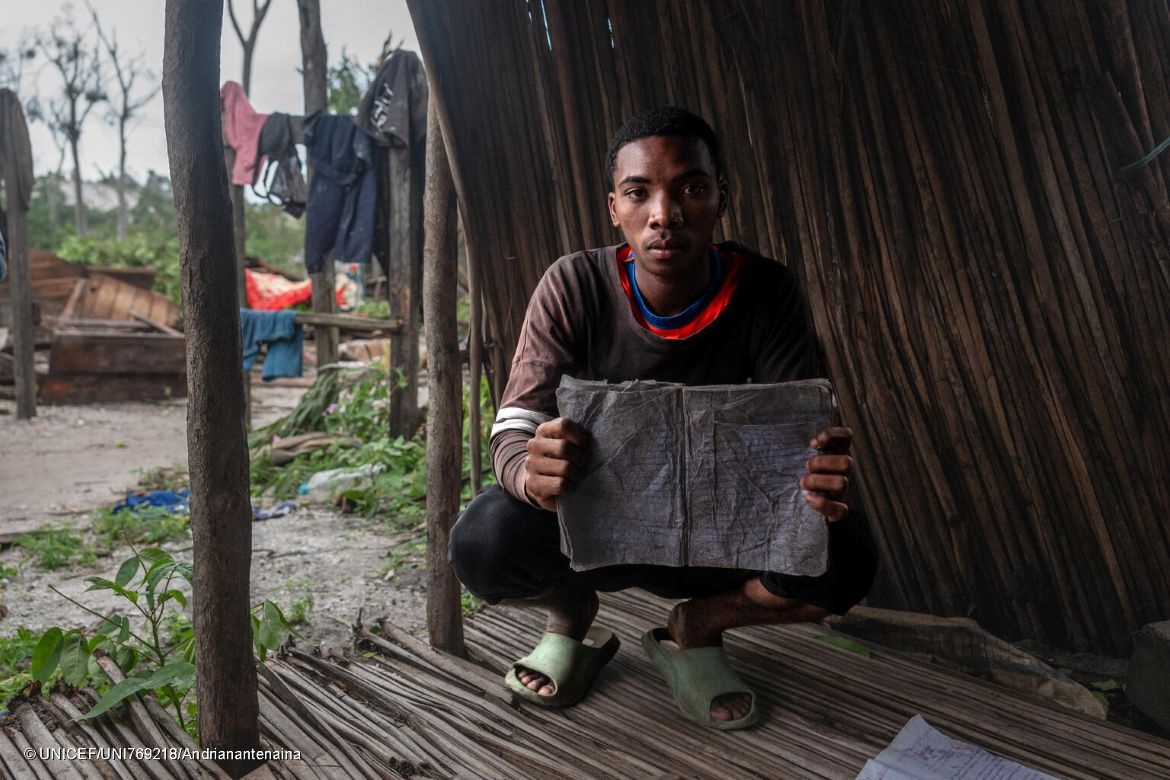
Mahasitraka Lucien, a second-year high school student at Lycée Paul In Bezavona, Madagascar, holding a wet notebook, after Tropical Storm Jude struck the Grand Sud region of Madagascar in March 2025. He shares: “All my notebooks and books are ruined. The exams are approaching, and I have to rewrite all my lessons.”

Credit:
UNICEF/UNI769218/Safidy Andrianantenaina

How countries are embracing anticipatory approaches

Education actors have long taken action to prepare before crises strike including by earthquake-proofing schools, making use of early warning systems and disaster risk reduction strategies that are child focused.

When it comes to anticipatory action more specifically, there’s still more work to do, including by mainstreaming its use across relevant interventions and building up an evidence base of its benefits.

This isn’t to say that there are no encouraging signs. As our report highlights, anticipatory action to mitigate crises is slowly but surely being embraced as evidence of its positive impact begins to emerge. These include saving resources for communities, aid actors and donors and most importantly, allowing children to remain in school even when disasters strike.

In Niger in 2022, for example, the aid community and local actors took several preemptive steps ahead of the annual lean season when floods and droughts are rife. These included launching cash-for-work initiatives and supporting education through grants.
As a result, some 10,000 children could remain in school who would otherwise have been pulled out to help their families or even be forced to leave their homes.

In September 2024, Education Cannot Wait also announced two new $5 million anticipatory action pilot schemes in Somalia and Pakistan. While it is too early to evaluate results, these important investments show that the education sector is moving in the right direction.

Leveraging climate finance investments is another promising avenue to scale up anticipatory approaches in education, as has been done by the Green Climate Fund, GPE and Save the Children through the Building the Climate Resilience of Children and Communities through the Education Sector (BRACE) initiative launched at COP28.

We must also not forget how much communities themselves value education.

Time and again when given the option, families will invest in children’s schooling.

In drought-ridden Kenya, for example, one pastoralist who previously had to pull children out of school to afford food explained the impact of anticipatory cash transfers: “After receiving the funds, I paid school fees for my children and used the rest to buy food and additional sheep.”

The good news is that there are many concrete and immediate steps that governments, practitioners, donors and other stakeholders can take to strengthen anticipatory approaches.

Local partnerships for polycrisis

In the current funding context, we must prioritize both increasing investment in acting ahead and protecting the limited funding that already exists.

To make this a reality, we have outlined 7 key asks in our report for national governments, donors, aid actors and others:

  1. Prioritize strategic investment in anticipatory approaches across sectors—including in education—and protect such investment where it already exists.
  2. Systematically integrate education into broader anticipatory frameworks, policies and funding mechanisms while expanding the use of anticipatory approaches in education sector plans, strategies and budget allocations.
  3. Amplify locally led anticipatory efforts including by tapping into the crucial knowledge of local teachers, civil society and authorities.
  4. Ensure that children and youth are active participants in anticipatory approaches, upholding their right to shape the decisions that will affect their future.
  5. Strengthen cross-sectoral collaboration on anticipatory approaches. Governments should ensure the crucial participation of ministries of education especially as they are often excluded from broader planning efforts.
  6. Integrate anticipatory action into longer-term, multi-hazard risk management strategies and include education as a key component.
  7. Continue to strengthen preparedness efforts and, where feasible, expand anticipatory action to armed conflict and situations of violence in which learning is severely disrupted and children and youth are particularly vulnerable.

There’s much at stake for the millions of children and youth we work for to make sure they continue to have access to education.

To really meet this moment, we need to think ahead and invest resources where they will really make a difference.

Related blogs

Comments

Embracing 'acting ahead' in education fosters innovation, adaptability, and future readiness. It prepares students for evolving challenges, ensuring they're not just reacting but leading with foresight. A proactive approach creates resilient learners and progressive educational systems.