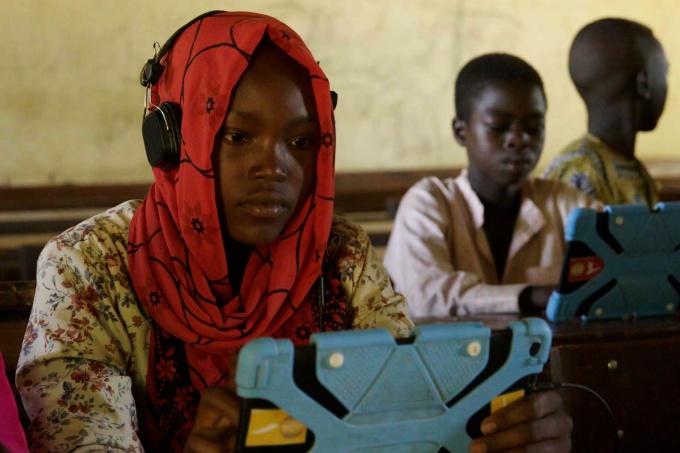
Student Samira Yaya studies on a tablet, part of an EdTech program developed by WarChild Holland named ‘Can’t Wait to Learn’, at a school in Djabel Refugee Camp, Eastern Chad. Credit: GPE/Michael Knief/AP

Partner since:

Total grant support: US$268,359,037

GPE 2025 grant eligibility:

  • Multiplier
  • Girls' Education Accelerator
  • System capacity
  • System transformation

Partnership Compact

Priority: Transforming the quality and performance of teachers for a more efficient, more equitable and more resilient education system.

Other key documents

Coordinating agency: PAM/WFP

Engagement lead: Blandine Ledoux

Transforming education in Chad

Chad has one of the highest learning poverty rates in the world: 94% of children aged 10 cannot read a simple, age-appropriate text. 

Chad's education system is impacted by high population growth, lack of financial resources, poverty, conflict, regional insecurity leading to population displacement, and the implications of climate change. 

To build a resilient system, the government is working with GPE and other partners to transform the quality and service delivery of teachers in a way that increases equitable access to quality education and ensures the success of basic education, especially for girls and the most vulnerable children. 

As outlined in Chad’s Partnership Compact, improving teacher professional development is expected to raise the level of mastery by teachers in both content and didactics. 

Teacher management will be optimized through fairer processes, enhanced motivation and attention to gender parity.

Chad also aims to improve critical factors for better learning, including data on the characteristics of children enrolled and to be enrolled, stronger articulation between fundamental learning and social and ecological skills, and provision of appropriate infrastructure and equipment for a safe school environment. 

A focus on girls’ education seeks to tackle barriers ranging from social norms to health, social protection and inclusion.

Result story

Advancing technology for learning in Chad

  • Chad welcomes 1.3 million displaced persons, including more than 1 million refugees from Sudan, Central African Republic, Cameroon and Nigeria, and these numbers are expected to rise.
  • This refugee crisis compounds the strain on Chad’s already underfunded education system.
  • GPE KIX has conducted research on scaling technology use to educate refugees, which can be used in other countries facing conflict and emergencies.

Key data

53%

out-of-school rate for children of lower-secondary school age

17%

of children start learning one year before entering primary school

64%

of primary teachers have the minimum required qualifications

15%

of government expenditure on education

Grants

(data as of November 11, 2026)

 
  • Type: Multiplier

    Years: 2026 - 2030

    Allocation: US$30,000,000

    Utilization: 0

    Grant agent: IsDB

  • Type: System capacity

    Years: 2026 - 2030

    Allocation: US$1,800,000

    Utilization: 0

    Grant agent: UNESCO, UNICEF

  • Type: System transformation and Girls' Education Accelerator

    Years: 2025 - 2028

    Allocation: US$105,520,000

    Utilization: US$19,466,539

    Grant agent: UNESCO, UNICEF

Civil society engagement

As part of its investment in civil society advocacy and social accountability efforts, GPE’s Education Out Loud fund is supporting:

  • The Coalition des organisations des sociétés civiles pour le développement au Tchad (COSOCIDE-Tchad) for the 2024-2026 period.

Learn more

Latest blogs and news

March 24, 2026
Why we still need a Girls’ Education Accelerator
The Girls’ Education Accelerator provides crucial, targeted funding to strengthen reforms that help girls facing the greatest barriers to schooling. As GPE’s dedicated window for girls’ education, it...